
Why it matters
The producer
Tenute Rio Maggio is a family estate in the Fermo hills of southern Marche, working two DOC appellations from a single vineyard in Contrada Vallone. Graziano Santucci founded the operation in 1976. After his death, his son Simone and Simone's wife Tiziana took over and, from 1997, planted dedicated vineyards for Rosso Piceno and Falerio dei Colli Ascolani. Tiziana leads the winemaking. Their daughter Alessia now works alongside them, bringing the family to a third generation on the same land.
The range is deliberately compact. Two DOC wines, one red and one white, both grown in Contrada Vallone. Vines are farmed organically, without irrigation. Grapes are picked by hand, selected bunch by bunch, and carried to the cellar in boxes holding no more than twenty kilograms. The logic is tight: a small site, a careful harvest, and wines that aim to carry the character of the place rather than the ambitions of the blending room.
Place and vineyards
Where the wines begin
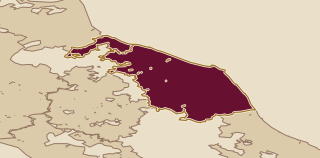
Montegranaro sits in the Fermo hills, a predominantly hilly stretch of southern Marche between the Apennines and the Adriatic coast. The province of Fermo occupies territory that falls between the older administrative centers of Ascoli Piceno to the south and Macerata to the north. Both of Rio Maggio's appellations, Rosso Piceno DOC and Falerio dei Colli Ascolani DOC, draw their geographic boundaries from this corridor between those two provinces.
Falerio dei Colli Ascolani is a white DOC built around Trebbiano, Pecorino, and Passerina, grapes that ripen into wines with herbal freshness and dry weight. Rosso Piceno is a red DOC anchored by Montepulciano and Sangiovese, two varieties that produce wines with dark fruit and firm acidity in these hills. The Contrada Vallone site, with its hilly aspect and what the estate describes as an extremely favorable microclimate, grows both red and white varieties for the two appellations from the same ground.
In the cellar
Vineyards and cellar
Organic farming and dry farming together mean the vines are not fed water from outside the site. In a hilly setting with good natural drainage, this keeps the vine under pressure and concentrates what each grape delivers. Hand harvesting with bunch selection at twenty kilograms per box preserves grape integrity between vine and cellar, avoiding bruising and oxidation before fermentation. The estate's philosophy applies this care to each variety separately, which means each grape arrives in the cellar as itself rather than as part of an undifferentiated load.
What is clear from the farming and handling approach is that the cellar work is intended to follow the vineyard rather than reshape it.
Wines to know
The range in view
Rio Maggio produces two DOC wines from the Contrada Vallone vineyard.
The Rosso Piceno DOC is the red, blended from 70 percent Montepulciano and 30 percent Sangiovese, with Montepulciano the larger share of the blend. The 2022 vintage runs at 14 percent alcohol, which reflects the ripening capacity of the hilly Fermo site in a warm season. Montepulciano brings dark cherry fruit and tannic grip; Sangiovese contributes acidity, red-fruit freshness, and a firmer spine. Together they make a wine with body and length that stays within the Rosso Piceno DOC framework, an appellation positioned between Ascoli Piceno and Macerata.
A useful way in
A bottle to begin with
Start with the Rio Maggio 2022 Rosso Piceno DOC. It is 70 percent Montepulciano and 30 percent Sangiovese from the Contrada Vallone vineyard, farmed organically without irrigation and picked by hand. The Montepulciano gives the dark fruit and tannic grip that define the style; the Sangiovese brings the acidity that keeps the wine from feeling heavy. At 14 percent alcohol it has enough body to stand beside food but enough freshness to finish cleanly. This is the wine that shows what Simone and Tiziana built from 1997: an appellation-focused red from a single hill site, made without shortcuts in the vineyard or the cellar.