
Why it matters
The producer
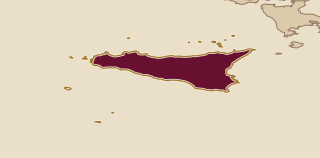
Dino Costantino recovered the terraces of Contrada Blandano during the 1970s and founded Terra Costantino in 1978. His son Fabio now works alongside him. The estate occupies the southeastern slope of Mount Etna, in the Sicilian comune of Viagrande, where the volcanic terrain sits at 450 to 500 metres above sea level and the aspect is warmer and lower than the northern and eastern slopes that generate most of Etna's international reputation.
Terra Costantino says it became the first winery on Etna to achieve organic certification, in 2000. That date matters because it places the commitment well before the international wine press discovered the volcano and before organic farming carried any commercial premium on the mountain. Luca D'Attoma joined as consulting oenologist in 2010, and in 2020 the family acquired approximately two hectares of terraces in Contrada Praino, in the commune of Milo, to produce Etna Bianco Superiore, a designation that legally requires vineyards within Milo at higher elevation.
Place and vineyards
Where the wines begin
Etna's southeastern slope is less discussed than the northern and eastern crus around Randazzo and Milo that dominate the wine press, but it is where the volcano's long history of agricultural use is thickest. Viagrande sits at moderate elevation, 450 to 500 metres on the estate's Blandano holding, where the lower altitude and southern exposure push ripeness further than the higher northern sites. Nerello Mascalese on this slope tends toward rounder red fruit and softer tannin rather than the more austere, high-acid character that the northern crus produce.
The Praino holding in Milo operates at higher elevation on Etna's eastern flank. Milo is the only commune whose vineyards qualify for the Etna Bianco Superiore DOC designation, which requires Carricante as the primary variety and restricts production to that zone. The Costantinos acquired Praino specifically to enter that designation, adding a geographically distinct white wine to a range otherwise concentrated on the southeastern slope.
In the cellar
Vineyards and cellar
All harvesting is manual. No irrigation is applied, which concentrates sugars and forces vines to develop deep root systems in the volcanic substrate. Pest control is organic throughout; the estate uses natural predators rather than synthetic treatments. Mixed-variety planting within the same terraces is maintained as a farming practice, not eliminated in favour of variety-separated monoculture.
The cellar is built underground, which keeps temperatures naturally cool without mechanical refrigeration. For deAetna Etna Rosso, destemmed grapes ferment on their skins for approximately ten days, with pump-overs to manage extraction without excess grip. After malolactic fermentation, the wine matures in a combination of stainless steel and medium-sized oak barrels before bottle ageing. The mix of vessel types and the relatively brief skin contact keeps the wine approachable rather than structured for long cellaring. The underground position of the cellar reduces energy use and allows passive temperature management across all wines in the range.
Wines to know
The range in view
The range divides into two tiers. The deAetna tier covers the entry-level Etna DOC wines: the Rosso, Bianco and Rosato. deAetna Etna Rosso is a blend of 90% Nerello Mascalese and 10% Nerello Cappuccio, fermented with ten-day skin contact and aged in steel and medium oak. It is pale ruby in colour, with bright red cherry and a light, fine-grained tannin typical of Nerello Mascalese at this elevation. The Bianco uses Carricante and Catarratto; the Rosato comes from the same red varieties. These three wines account for the bulk of the estate's 40,000-bottle annual production and are built for early drinking.
A useful way in
A bottle to begin with
Contrada Praino Etna Bianco Superiore is the bottle that says most about where Terra Costantino is going. It is Carricante from a specific location in Milo, the only commune allowed to use the Superiore designation, planted and built specifically for that wine. In the glass it is pale gold, with tight lemon and white grapefruit on the nose, a firm acid line through the palate, and a mineral, saline finish that the basalt substrate drives. There is no oak and no sweetness. Start here to understand what Carricante can do at altitude on Etna's eastern flank, and what distinguishes this estate from its own entry tier.