
Why it matters
The producer
Terre Cevico is not a family estate or a single domaine. It is an agricultural cooperative founded in 1963 in Lugo, a town in the Ravenna province of Emilia-Romagna, built from 5,000 vine-growing families farming more than 7,000 hectares. The grapes are theirs. The cellar infrastructure, agronomic guidance, oenological support, and commercial strategy belong to the cooperative.
That division of labour is the whole model. Member families grow and harvest. Terre Cevico stations agronomists and oenologists in the vineyards to steer quality decisions, then coordinates everything from winery to label to export channel from the Lugo headquarters. The resulting wines are not single-parcel expressions or classified cru selections. They are well-made, freshness-oriented bottles designed for accessible, consistent drinking across a wide market.
Place and vineyards
Where the wines begin
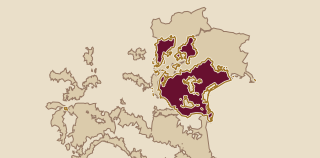
The commercial heart of Terre Cevico is Lugo, a flat agricultural town roughly equidistant between Bologna and the Adriatic coast. Emilia-Romagna is one of Italy's highest-volume wine regions: the Po Plain soils and the warm continental climate favour productive Sangiovese, Trebbiano and Albana cultivation at scale. Romagna, the eastern half of the region, is where the cooperative's founding membership farmed and where Sangiovese remains the primary red grape.
Beyond Romagna, the cooperative's wineries reach north into the Veneto and Friuli Venezia Giulia, where the range includes lighter whites suited to the cooler northern climate, and south into Puglia, where the heat and older vine material support fuller-bodied reds. The Sicilian and Tuscan partnerships feed grapes including Catarratto, Inzolia and Syrah into the organic Sancrispino range. The label architecture follows the geography: each brand draws from its own regional growing base rather than blending across the whole network.
In the cellar
Vineyards and cellar
Terre Cevico places agronomists and oenologists directly with member growers, which means the 7,000-plus hectares of member vineyards are farmed with at least some cooperative oversight rather than being left entirely to individual family judgment. The cooperative uses filtration and stabilization systems designed to reduce filtration media and residual waste, a practical sustainability measure that also reflects the scale at which any process decision compounds across millions of litres.
The Leale Sangiovese Rosato is made by short skin maceration of several hours before stainless-steel fermentation. The brief contact pulls colour and a light cherry fruit character from the Sangiovese skins without extracting tannin, and the cool stainless-steel fermentation preserves the fresh, fruit-forward aromatic profile. The Sancrispino Organic bottles must meet certified organic standards across grape growing and cellar work, which adds another layer of process discipline to those particular ranges.
Wines to know
The range in view
Terre Cevico builds its ranges by label and regional grape, not by appellation hierarchy or single-vineyard prestige. The bottles are priced at mid-market and below, designed for regular drinking rather than cellar ageing.
Leale is the flagship label. The Leale Toscana Sangiovese Rosato, made entirely from Sangiovese with a short skin maceration before stainless-steel fermentation, is pale-coloured, lively and light-bodied, with cherry, currant, watermelon and grapefruit-zest character and a brief, clean finish. The Leale Sangiovese red, from the same grape, carries darker fruit, earthy undertones and mild spice, with moderate tannins and accessible acidity. Both are designed for immediate drinking.
A useful way in
A bottle to begin with
Start with the Leale Toscana Sangiovese Rosato. It is made from 100 percent Sangiovese, the grape that has defined Romagna and Tuscany for centuries, here vinified as a pale rosato: short skin contact of a few hours to capture colour and cherry-fruit character, then cool stainless-steel fermentation to keep everything fresh. It is light-bodied, with lively acidity, cherry and watermelon on the nose and a grapefruit-zest lift on the finish. It carries no oak, no tannin, no residual sweetness to speak of. It is exactly what it announces itself to be, made honestly from a well-known grape by a cooperative with the technical resources to get the basics right.