
Why it matters
The producer
Moncaro is a wine cooperative headquartered in the hill town of Montecarotto, in the Marche region of central Italy. Its member-growers farm roughly 1,600 hectares across three geographically separate wineries, each built around a different appellation and a different grape. The operation is large by any regional measure, yet the detail that defines it is not scale but timing: Moncaro began experimenting with organic viticulture in 1980, decades before organic farming became a commercial expectation in Italian wine.
The cooperative trades under two names. Moncaro is the umbrella: the institution, the membership, the three wineries. Terre Cortesi is the quality signal. The phrase, which translates loosely as "the courtly lands," was coined in 1995 when Moncaro expanded beyond its Montecarotto base and acquired the Conero winery on the Adriatic coast. From that acquisition onward, Terre Cortesi has labelled the wines the cooperative considers its most significant.
Place and vineyards
Where the wines begin
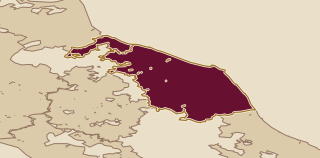
Marche runs down the central Adriatic coast of Italy, bounded by the Apennines to the west and the sea to the east. The region is not one wine zone but several, and Moncaro's three wineries mark three of the most important.
At Montecarotto, in the inland hills of the Castelli di Jesi zone, the appellation is Verdicchio dei Castelli di Jesi Classico. Verdicchio is the dominant white grape of central Marche: thick-skinned, high-acid, and capable of considerable texture when handled carefully. The Classico designation marks the oldest and most established part of the appellation's territory.
In the cellar
Vineyards and cellar
Each winery runs its own cellar protocol, matched to the grape and the appellation.
At Montecarotto, the focus is freshness. Grapes from the 450 hectares of Verdicchio dei Castelli di Jesi Classico are processed separately by soil origin, then pressed with pneumatic presses that apply gentle, even pressure to limit oxidation and bitterness. Temperature control holds the ferment cool. Oxygen protection continues through the winemaking process, and extended lees contact after fermentation builds texture and weight in the finished wine without sacrificing the acidity that defines the grape.
Wines to know
The range in view
The range maps directly onto the three wineries and their appellations.
Verdicchio dei Castelli di Jesi Classico covers the whites from Montecarotto. These wines carry the bright acidity and faintly bitter almond finish that Verdicchio produces on limestone and clay. Lees contact adds a creamy mid-palate weight. The wines range from fresh entry-level bottles to more substantial cuvées that develop further complexity with a year or two of age.
A useful way in
A bottle to begin with
Gio Rosso Piceno 2025 is the right first bottle. It is a Montepulciano and Sangiovese blend from the Acquaviva Picena vineyards, grown on hillside sites between 200 and 400 metres above sea level. The nose is generous and clear: dark cherry, blueberry, violet, a touch of raspberry, chocolate, and sage. The palate is medium-bodied and fruit-forward, with moderate oak and enough acidity to keep it from feeling heavy. It is not a long, structured wine, but it covers the Piceno appellation honestly and gives a clear picture of what Moncaro does with the region's two main red grapes grown at altitude.