
Why it matters
The producer
Terreno is a Chianti Classico estate that sits immediately outside Greve in Chianti, with vineyards spread across the Greve and Montefioralle communal zones in the DOCG's northern reaches. The Swedish Ruhne family has owned it since 1988. Sofia Ruhne runs it now, and the arc of how she got there is more deliberate than most succession stories.
She made her first wine at Terreno in 2010 while still living elsewhere, moved to the property full-time in 2011, spent the next three years guiding the organic transition with her father, and formally took over in 2015. Tuscany-based oenologist Giacomo Fioravanti, who spent more than a decade at Isole e Olena before joining Terreno, advises the cellar. The combination of a driven young director and a technically grounded oenologist from one of Chianti Classico's more methodical estates gives Terreno a clear working philosophy: farm well, intervene as little as possible, and let vintage conditions dictate vessel choice.
Place and vineyards
Where the wines begin
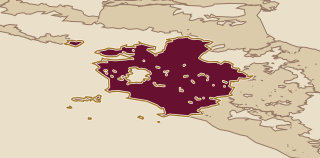
Greve in Chianti is one of the DOCG's principal towns and the commercial heart of the northern zone. As a UGA, Greve covers substantial altitude variation and a range of exposures, typically producing Sangiovese with firm tannin and lively acidity, shaped by its galestro and alberese soils. Galestro is a friable, schistose rock that drains quickly and limits vine vigour; alberese is a harder, calcium-rich clay-limestone that opens slowly and pushes ripeness later into the season.
Montefioralle is a small medieval hilltop commune a few kilometres from Greve town, elevated above the valley floor, with clay-rich and volcanic soils that tend toward more concentrated fruit and a darker, fuller mid-palate in the wine. As a UGA it is compact and little-planted relative to the broader DOCG, which means individual parcel character matters more.
In the cellar
Vineyards and cellar
Harvesting at Terreno is done entirely by hand. After the initial pick, grapes go through a second manual sorting at the cellar to remove anything underripe or damaged before fermentation begins. The effect is visible in the wine: only grapes at a uniform ripeness level enter each tank.
Fermentation is spontaneous across the range. No commercial yeast is added; native yeast populations from the vineyard and cellar carry each ferment. This increases vintage variation but also links the wine more directly to the soil and season it came from.
Wines to know
The range in view
Terreno builds its range in three tiers, each anchored to a distinct geographic and ageing logic within the Chianti Classico DOCG.
Le Tre Vigne (Chianti Classico DOCG) is the estate's main wine and takes its name from the three vineyard plots that supply it. Sangiovese leads the blend, with Canaiolo and Colorino alongside; the wine draws on parcels in both the Greve and Montefioralle UGAs. On the palate, Le Tre Vigne shows the dark cherry and dried herb character typical of northern Chianti Classico Sangiovese, with firm but supple tannin, medium body, and the kind of bright acidity that keeps the wine fresh through a long meal. Versatile enough to open young and capable of several years in bottle.
A useful way in
A bottle to begin with
Start with Le Tre Vigne. It is a Chianti Classico DOCG from Sangiovese grown across Terreno's Greve and Montefioralle parcels, and it carries the full range of what the estate is doing in a bottle priced for regular drinking rather than occasion. Bright acidity, dark cherry, firm tannin that softens with an hour of air or a plate of food. Nothing here is obscured by heavy oak or pushed to overripe sweetness. Le Tre Vigne is Terreno at its most direct: organic fruit, spontaneous fermentation, minimal intervention, and the northern Chianti Classico character intact in the glass.