
Why it matters
The producer
Testament Winery works from an organic vineyard at Jadrtovac near Šibenik, where the vines were planted in 2007. Juraj Sladić and Igor Radovanović make wines from Croatian grapes that take clearly different forms in the cellar: Pošip remains in stainless steel with lees stirring, while Babić is fermented and matured in barrique. The result is a compact range in which the white leans on citrus-like freshness and texture, and the red carries darker fruit, acidity and grip.
Zhoda Investments acquired Testament in spring 2017 and reports full ownership of Testament Winery and Black Island Winery. Its current scale figure—250,000 vines on 50 hectares—puts the young Jadrtovac planting at the centre of the operation, with Pošip and Babić providing the clearest view of how those vines are turned into bottles.
Place and vineyards
Where the wines begin
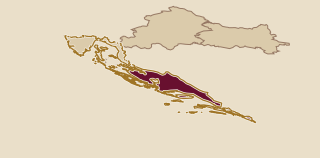
Testament’s vineyards sit in Northern Dalmatia near Šibenik, with Jadrtovac named as the estate’s vineyard location. That link is most direct in Babić: the grape is associated with the Šibenik area, and Testament treats it as a structured red rather than a light-fruited style. The location on the bottle is therefore not background detail; it connects a regional grape with a wine built around dark fruit, acidity and barrel ageing.
Pošip provides the counterpoint. In the Testament range, this Croatian white grape is not covered by oak: stainless steel and lees contact keep mineral notes, freshness and a fuller texture in view. Together, the two wines locate the estate through grape choice as much as through the map.
In the cellar
Vineyards and cellar
Organic production begins at Jadrtovac, while the cellar separates Testament’s two principal expressions. Pošip is fermented in stainless steel and worked on its lees. Without barrel flavour in the foreground, the wine can carry mineral notes and freshness while lees stirring adds texture through the middle of the palate.
Babić follows a broader-shouldered route. It is fermented and matured in barrique, a choice that supports the grape’s substantial structure rather than replacing it. The supported profile combines dark fruit with lively acidity and tannin, so the barrel-aged red has weight and grip instead of merely sweet oak character.
Wines to know
The range in view
The range is easiest to read as a white-and-red contrast. Pošip is Testament’s stainless-steel wine: lees stirring gives body and texture, while mineral freshness keeps the fruit dry and lively. It is the bottle for seeing what the estate does when oak is left out of the equation.
Babić is the red side of the range, made from a grape linked to the Šibenik area and matured in barrique. Its architecture is darker and more structural: fruit is held by acidity, tannin supplies grip, and barrel ageing adds breadth. The 2022 Babić has been assessed with blackberry, cordial, mineral notes, strawberry confit and figs, alongside integrated tannins.
A useful way in
A bottle to begin with
Choose Testament Babić 2022 first. It brings the estate’s core decisions into one glass: a Babić from the Šibenik area, fermented and matured in barrique, with blackberry, cordial, strawberry confit and fig notes. The palate is juicy but structured, with lively acidity and integrated tannins carrying the fruit through the finish.