
Why it matters
The producer
The Hilt is a Sta. Rita Hills estate defined by a deliberate choice of ground. Chardonnay and Pinot Noir are planted across Bentrock, Radian and Puerta del Mar, so the range can move from blended Estate wines to more narrowly drawn vineyard releases. That structure matters in the glass: the Estate wines show the breadth of the property, while the single-vineyard bottles concentrate attention on a particular slope and planting.
Before acquiring the property in 2014, Dees and his team spent several years buying fruit from sites across the Sta. Rita Hills. That work let them compare blocks and subregions before committing to one estate. Their eventual choice—a cool, north-facing site in the southwest corner—was not simply a land purchase: it established the conditions for Chardonnay with acidity and Pinot Noir with measured weight, floral or herbal notes, and savoury grip.
Place and vineyards
Where the wines begin
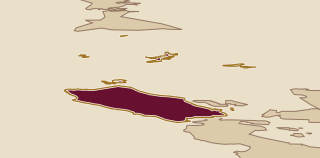
Sta. Rita Hills lies in northwestern Santa Barbara County, and The Hilt occupies its southwest edge. Dees and his team sought a north-facing position as close to the ocean as possible after studying sites across the appellation. The coastal exposure brings cooling breezes, extending the growing season; Chardonnay can retain bracing acidity while Pinot Noir can develop fruit and herbal detail without losing its line.
Bentrock covers close to 100 acres, with 13.6 acres of Chardonnay and the balance Pinot Noir. It rises from roughly 400 to more than 500 feet, where cooling breezes slow ripening. Clay, sediment and shale form the main soils, with outcrops of diatomaceous earth; the result is a site chosen for gradual flavour development rather than quick accumulation of sugar.
In the cellar
Vineyards and cellar
At Bentrock, slow ripening under cooling breezes is a vineyard fact with a direct wine consequence. Chardonnay can carry richness without losing citrus-driven acidity, while Pinot Noir can keep freshness beside cherry fruit, earth and spice. The estate’s north-facing position supports that pattern across the range rather than relying on a late-picked, high-alcohol style.
The Estate tier draws on more than one estate vineyard, using blending to bring together the property’s separate elevations and soils. The single-vineyard releases take the opposite approach, leaving Bentrock, Radian or Puerta del Mar more exposed on the label. The cellar has also made sparkling wine, a format first explored when an unusually cool season delivered fruit with modest alcohol.
Wines to know
The range in view
The core range is Estate Chardonnay and Estate Pinot Noir, followed by wines named for Bentrock, Radian and Puerta del Mar, with sparkling wine adding another expression of the cool setting. The Estate pair is the blended level: Chardonnay brings creamy texture and bright acidity, while Pinot Noir moves toward layered fruit, herbs and gentle tannin.
Single-vineyard bottlings narrow the frame. Bentrock’s slow-ripening fruit comes from clay, sediment, shale and diatomaceous-earth soils at 400 to more than 500 feet; Radian reaches nearly 700 feet. These labels are useful when the aim is to taste a particular estate vineyard rather than the combined shape of the property.
A useful way in
A bottle to begin with
Start with The Hilt Estate Chardonnay 2021. It gathers the estate’s central proposition into one bottle: Chardonnay from a cool, ocean-influenced Sta. Rita Hills property, blended from estate vineyards rather than restricted to one parcel. Its creamy, rich texture is held by bracing acidity, making the contrast between ripeness and freshness easy to feel from the first sip through the dry finish.