
Why it matters
The producer
The Sadie Family Wines began with Eben Sadie in 1999, then put its first Columella vintage into bottle in 2000. From Malmesbury in Swartland, the producer works through two forms: blended Signature Series wines and nine Old Vine Series bottles. Columella brings several old-vine vineyards and red varieties together; Treinspoor takes one Tinta Barocca vineyard as its subject. The contrast lets a label signal whether the wine is assembled from dispersed sites or centred on one old-vine parcel.
The Signature Series grew from work Eben Sadie undertook with viticulturist Rosa Kruger to find, revive and sometimes save old Cape vineyards. That search supplied vineyards for Columella and Palladius, wines built from more than one site rather than from a newly planted estate block. Organic farming began in 2014, extending the work from locating old vines to tending them under an organic programme. The resulting bottles keep old vineyards present both as farming material and as named components of the range.
Place and vineyards
Where the wines begin
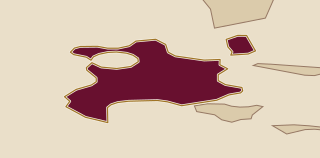
Malmesbury places the producer in Swartland, within the Western Cape, but the working landscape is wider than the town’s postal address. The team farms 26 hectares of estate vines and 24 leased hectares across 54 parcels. That spread matters because Columella and Palladius can combine material from several places, while an Old Vine bottle such as Treinspoor can hold to one vineyard’s variety, soil and planting history.
Treinspoor comes from Tinta Barocca vines planted in 1974 beside an old railway line west of Malmesbury. Decomposed granite and Table Mountain sandstone are the documented ground beneath that vineyard, and the bottle carries the site’s name rather than a blend name. Its dark-berry and Earl Grey notes give the soil-and-vineyard discussion a glass-level consequence: this is a red shaped around one parcel rather than a composite cuvée.
In the cellar
Vineyards and cellar
Fifty-four parcels require vineyard decisions to be made site by site, whether the vines are estate-owned or leased. The producer’s permanent vineyard workforce works year-round from pruning through harvest, and the organic programme has run since 2014. In the cellar, most red grapes ferment as whole clusters, so skins, juice and stems meet together; whole-bunch pressing gives white grapes a different route into the press. Limited-production wines are made without additions and with little manipulation, leaving fruit, acidity, tannin and texture to carry the wines rather than a heavily altered cellar profile.
Wines to know
The range in view
Columella and Palladius form the Signature Series. Columella is a Swartland red drawn from old-vine vineyards, predominantly Syrah with Mourvèdre, Grenache, Carignan and Cinsault. It spends 24 months in oak and is racked every six months, giving the blend time to gather its berry fruit, powdery tannin and medium body into one wine. Palladius takes the white route: old bush-vine Chenin Blanc leads a blend of 11 grape varieties from 17 vineyard sites, so its white-fruit, acidity and texture come from a far wider set of vineyards than a single-parcel wine.
The Old Vine Series contains nine wines, including Treinspoor, Soldaat, Songvang, Pofadder, Mev. Kirsten and Kokerboom. These labels shift the emphasis from multi-site blending to particular old-vine places. Treinspoor is the clearest example: Tinta Barocca, one 1974 planting, dark berry fruit and an Earl Grey note. Columella uses several red grapes and old-vine vineyards for layered tannin and fruit; Treinspoor uses one grape and one named vineyard for a more narrowly framed red.
A useful way in
A bottle to begin with
Start with Columella. It is the first wine the producer released, and its current form joins the central threads of the estate: old Swartland vineyards, a Syrah-led blend, whole-cluster red fermentation and 24 months in oak. The 2022 has medium body, berry fruit, powdery tannins, bright acidity and mineral detail, so it offers both immediate fruit and a firm, dry structure. It also clarifies why the Signature Series is built as a blend: several parcels and varieties are brought into one bottle.