
Why it matters
The producer
Jean-Luc Thunevin and Murielle Andraud built Château Valandraud from a very small Saint-Émilion beginning: an initial 0.6-hectare parcel at Fongaban. Valandraud is the core Bordeaux estate, while Virginie de Valandraud and 3 de Valandraud extend its wine family at different levels. In 2012, Château Valandraud entered the Saint-Émilion classification as Premier Grand Cru Classé B, a formal milestone after two decades of work around the original holding.
The project began with land before there was a finished wine. A separate account dates Thunevin and Andraud’s purchase of the first 0.6-hectare Fongaban parcel to 1989; Valandraud dates the creation of its wine and its first vintage to 1991. From there, the work widened beyond the original Saint-Émilion plot. Clos Badon-Thunevin joined in 1998, while Valandraud developed a family of labels that can carry fruit from the estate into different bottles. The result is a name rooted in one small holding but expressed through several Saint-Émilion reds and a distinct Maury partnership.
Place and vineyards
Where the wines begin
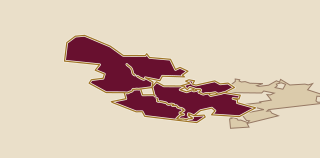
Saint-Émilion is the Bordeaux setting for Valandraud and Clos Badon-Thunevin. At Valandraud, the Fongaban parcel matters because it was the small physical starting point from which the estate’s red-wine project grew. Clos Badon-Thunevin, acquired in 1998, adds another Saint-Émilion property to the story and was promoted to Grand Cru Classé in 2022. Thunevin-Calvet Maury belongs elsewhere: it is a Languedoc-Roussillon connection, so its Grenache should not be read as part of the Saint-Émilion wines.
Valandraud’s principal red-wine soils are clay and limestone. Those materials help frame the estate’s concentrated, structured Bordeaux direction, which is then reinforced by pruning and crop management in the vineyard. At Clos Badon-Thunevin, traditional soil work is used across about 90% of the vineyard to encourage deep rooting and maintain biological activity; the site has also served as an experimental vineyard for the team since the 2000s.
In the cellar
Vineyards and cellar
At Valandraud, double-Guyot pruning, de-suckering and green harvesting concentrate attention on the fruit that remains on the vine. That work is paired with a cellar programme in which malolactic fermentation takes place in French oak barrels, then the wine spends 18 to 30 months in entirely new French oak, depending on the vintage. The consequence is not a neutral red: oak, dark-fruit weight and tannin are active parts of the wine’s shape, especially when the bottle is young.
Wines to know
The range in view
Château Valandraud is the central Saint-Émilion wine, made through the estate’s clay-and-limestone vineyard work and extended new-oak ageing. Virginie de Valandraud sits within the same family and, in 2020, showed a full-bodied palate of creamy dark fruit, milk chocolate and spice.
3 de Valandraud is made from declassified Valandraud and Virginie de Valandraud fruit. Its 2018 blend was 65% Merlot, 30% Cabernet Franc and 5% Cabernet Sauvignon, bringing blackcurrant, dark cherry, plum, blackberry, violet and liquorice together with softened tannins, integrated oak and freshness. Clos Badon-Thunevin is a separate classified Saint-Émilion property. Beyond Bordeaux, Thunevin-Calvet Maury 2015 is a separate 100% Grenache wine.
A useful way in
A bottle to begin with
Start with 3 de Valandraud 2018. It is a Saint-Émilion blend of 65% Merlot, 30% Cabernet Franc and 5% Cabernet Sauvignon, made from fruit declassified from Valandraud and Virginie de Valandraud. Blackcurrant, dark cherry, violet and liquorice lead into integrated oak, softened tannin and a fresh, long finish. It introduces the Valandraud family through a bottle where grape proportions, range role and palate structure are all clearly documented.