
Why it matters
The producer
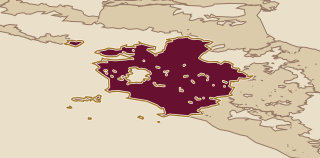
In southeastern Tuscany, away from the prestige addresses of Chianti Classico, around 400 growers pool their harvests under one label. Cantina dei Vini Tipici dell'Aretino, headquartered in Arezzo province, farms some 800 hectares across the Chianti Colli Aretini sub-zone and neighbouring Valdichiana. The cooperative was founded in 1970 and made its first wine in 1971 from grapes contributed by its member growers.
This is how most Chianti at retail actually gets made. Not by a single family farming a named parcel, but by a cooperative that consolidates small growers who could not otherwise afford the equipment, certification, or export infrastructure to bottle under their own name. Tipici dell'Aretino is that model at a meaningful scale: a bottle of its Chianti DOCG represents 800 hectares of Arezzo hillside, dozens of individual decisions in the vineyard, and a cellar large enough to require a patented fermentation system.
Place and vineyards
Where the wines begin
Arezzo is not Chianti Classico. The Chianti Classico zone sits to the northwest, between Florence and Siena. Chianti Colli Aretini is the southeastern sub-zone of the broader Chianti DOCG. The hills here are less famous and the soils more variable, which is precisely why cooperatives took root: the territory was too scattered and the producers too small to command individual attention.
The Valdichiana to the east runs down toward Umbria, a flatter valley corridor oriented more toward whites, particularly Trebbiano and Chardonnay. The cooperative's DOC Valdichiana wines follow that logic. The Chianti Colli Aretini sub-zone label carries legal significance: it identifies wines from Arezzo's hills specifically and places them within the wider Chianti DOCG family, with Sangiovese as the required backbone grape.
In the cellar
Vineyards and cellar
The 800 member-farmed hectares are managed by individual growers under the cooperative's shared agronomic guidance. Grapes are harvested and contributed to the central cellar, where the Metodo Ganimede system handles the red wine fermentation. The Ganimede method works by combining skin-liquid contact with temperature-controlled fermentation in purpose-built tanks, producing homogeneous maceration across large batch volumes and reducing overall vinification time. For a 15,000-hectoliter operation, uniformity across tanks is not a cosmetic goal; it is what keeps the Chianti DOCG bottling coherent across a full harvest.
For the white wines, the cooperative emphasizes cool fermentation and early bottling. The Vermentino and Chardonnay in the D'Estate line show the result: aromatic, forward wines built for early drinking rather than extended ageing.
Wines to know
The range in view
The range divides along grape and appellation lines. Sangiovese drives the reds: Chianti DOCG is the flagship, supported by Chianti Colli Aretini DOCG and Chianti Superiore DOCG. Super Tuscan IGT Toscana reds round out the red range for those wanting a step outside the DOCG rules. The Chianti Colli Aretini designation places these wines squarely in Arezzo's hills, a sub-zone producing Sangiovese with a little less tannin weight than Chianti Classico and a fruit character that trends toward ripe cherry and dried herbs.
The whites are built around two Vermentino expressions and a Chardonnay. D'Estate Vermentino is the commercial anchor: straw-yellow with golden tints, fresh and floral on the nose with white fruit, and savory and direct on the palate with solid length. The Toscana Vermentino IGT runs a parallel track with paler, greener colour, a bouquet carrying exotic fruit alongside the floral notes, and a rounder, drier body. The D'Estate Chardonnay completes the fresh-white tier.
A useful way in
A bottle to begin with
D'Estate Vermentino IGT Toscana is the right first bottle from this cooperative. It is made from Vermentino grown in Arezzo province under the IGT Toscana classification, vinified without oak and bottled for early drinking. The colour is straw-yellow with a golden warmth. The nose lifts immediately with jasmine and white peach. The palate is savory and fresh, with a clean acid line and good length. It is straightforward, honest, and well-made.