
Why it matters
The producer
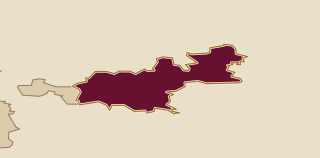
Tokaj-Oremus sits in Tolcsva, a hill village in northeastern Hungary's Tokaj wine region, and operates from cellars carved into tufa rock whose tunnels date to the 13th century. The estate belongs to the Álvarez family, who built Vega Sicilia into one of Spain's most closely followed red wine estates before turning east in 1993. What they found in Tokaj was a region famous for sweet wine but largely dormant: the collective farms of the communist era had broken the private estate model, and the cellars had passed through decades of state control.
The choice they made was not simply to revive Tokaji Aszú production. They built a full range, splitting output equally between dry Furmint and sweet botrytized wines. That decision placed Tokaj-Oremus at the centre of a shift in how Tokaj presents itself: a region producing serious dry white wine alongside its legendary sweet tradition.
Place and vineyards
Where the wines begin
Tokaj sits at the confluence of the Tisza and Bodrog rivers in northeastern Hungary, and the mists that rise from those rivers in autumn trigger noble rot on Furmint grapes left on the vine. The hills are volcanic in origin, with andesite and rhyolite tuff forming the dominant soil types on the steeper slopes. Those soils give Furmint a stony, smoky mineral edge that appears in both the dry wines and the sweet ones.
The Tokaji Aszú appellation governs the sweet botrytized wines. Puttonyos is the historic measure of sweetness: each puttony counted the hods of hand-selected botrytised grapes added to a barrel of base must. More puttonyos means higher residual sugar and greater concentration. The dry wines carry no appellation sweetness classification; they are labelled by vineyard name and position in the range hierarchy.
In the cellar
Vineyards and cellar
Furmint dominates every wine in the range. In the Mandolás, blending from multiple first-class sites evens out vintage variation and gives the wine breadth across its fruit register: pear skin, green apple, citrus zest, white flowers. In the Petrács, single-vineyard sourcing from old vines on andesite narrows the focus to crushed stone, citrus oil, and subtle herbal notes, with a tightly woven texture that favours long ageing over early approachability.
The 13th-century tufa cellars provide naturally stable humidity and cool temperatures through the year, the same conditions that originally made them suitable for ageing Aszú. For the sweet wines, botrytised grapes are harvested by hand in multiple passes through the vineyard as noble rot develops unevenly. The Furmint grape's high natural acidity is the structural backbone in every Aszú level: it prevents the concentrated fruit and residual sugar from becoming heavy.
Wines to know
The range in view
The range divides cleanly into dry and sweet, with Furmint as the operative variety throughout.
Mandolás is the dry entry point: 100% Furmint from multi-vineyard first-class sites. The 2023 vintage opens on pear skin, green apple, citrus zest, and white flowers, with a taut, linear body driven by vibrant acidity rather than weight. A gentle phenolic grip adds texture without hardness, and the finish is saline and mineral. The wine develops gracefully over a decade.
A useful way in
A bottle to begin with
Start with the Mandolás. It is 100% Furmint from multi-vineyard first-class sites, dry, mineral, and structured around acidity rather than fruit weight. The 2023 vintage gives pear skin, green apple, citrus zest, and white flowers on the nose, then a taut, linear palate with a gentle phenolic grip and a saline, stony finish. No sweetness. No oak weight to learn through. The volcanic character of the Tokaj hills comes through clearly: that stony, slightly smoky mineral edge that distinguishes Furmint grown on andesite from white wine produced almost anywhere else. The bottle develops over a decade, but it is already open and expressive young.