
Why it matters
The producer
Tommasi Family Estates arrived in Tuscany from a different direction than most. The family spent nearly a century building one of the Veneto's most complete wine operations, rooted in Valpolicella Classica where Giacomo Tommasi planted the first parcel in 1902. By the time the fourth generation took the keys in 1997, the portfolio covered 800 hectares across seven Italian regions. Tuscany was the next move.
The Tuscan chapter has two addresses. Poggio al Tufo sits in the Maremma on 200 hectares of coastal plain, producing a Sangiovese-Cabernet blend called Rompicollo alongside a varietal Cabernet Sauvignon and a Vermentino white. Podere Casisano, acquired in 2015, is the serious one: a 53-hectare estate outside Montalcino with 22 hectares under vine, nine of them planted to Brunello. The family came to Montalcino not to pivot away from the Veneto but to add the one Tuscan appellation that belongs in the same breath as Amarone.
Place and vineyards
Where the wines begin
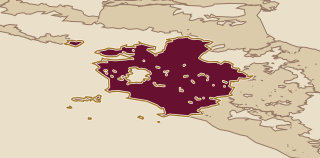
Montalcino is a hilltop town in the province of Siena, southeast of Florence, and the appellation that carries its name is among the most tightly governed in Italy. Brunello di Montalcino DOCG is reserved for 100% Sangiovese Grosso, a local selection of Sangiovese with thicker skin and higher colour intensity than the grape grown elsewhere in Tuscany. The elevation of the Montalcino hill, between roughly 250 and 600 metres, means warm days and cold nights through the growing season: fruit ripens fully while acidity stays high and tannin remains firm. Those conditions are why Brunello ages well and why its drinking windows run years, sometimes decades, after release.
At Poggio al Tufo in the Maremma, the 200-hectare property includes varied coastal soils suited to both Sangiovese and international varieties. Specific soil breakdowns for the Maremma parcels are not detailed in the available sources.
In the cellar
Vineyards and cellar
At Casisano, the Brunello is made from a single grape: Sangiovese Grosso. After harvest, the grapes macerate on their skins for approximately 25 days. That extended contact extracts colour, tannin, and the aromatic complexity that Brunello needs to sustain three years of oak ageing without thinning out.
The oak regime is deliberately large-format. Casks hold up to 60 hectolitres, which means the wine touches far less wood surface per litre than it would in barriques. Large Slavonian oak contributes oxygen and gentle tannin exchange over the three-year ageing period without overlaying the Sangiovese with toasty or vanilla characters. The wine then spends a minimum of six months in bottle before release. The total time from harvest to shelf runs well over four years for the Brunello.
Wines to know
The range in view
The Casisano range is anchored by two bottles from Sangiovese Grosso. The Brunello di Montalcino DOCG draws from nine hectares of dedicated vineyard and goes through the full traditional programme: long maceration, three years in large Slavonian oak, then bottle time before release. It is a wine built for the medium term, with firm tannins, marked acidity, and the dried-fruit depth that comes from the extended oak period. The 2015 vintage opens from 2024 and holds through 2030. The Rosso di Montalcino DOC draws from a separate seven hectares and offers an earlier-drinking Sangiovese Grosso from the same estate, released sooner, with the same Montalcino address but a shorter cellar requirement.
Rompicollo from Poggio al Tufo reads differently: the nose is darker and more savoury, with blackberry, ink, and a faint smoky quality. The palate is richer and more immediately giving, with spice and fruit forward and the mineral note coming in on the finish. It is a wine that works without waiting.
A useful way in
A bottle to begin with
Casisano Brunello di Montalcino DOCG is the bottle to open first. It is 100% Sangiovese Grosso from nine hectares on the Montalcino hill, macerated for 25 days and aged three years in large Slavonian oak before bottle time. The glass delivers firm tannins, bright acidity, red fruit and spice with dried-cherry depth, and a long dry finish. There is no oak flavour to speak of, only the integration that comes from years in large casks. The 2015 vintage is in its drinking window now and holds through 2030. Open it with a long decant and food, and the wine gives back everything the cellar put in.