
Why it matters
The producer
Montes Toscanini farms 90 hectares in Canelones, the wine-producing heartland of Uruguay, split across two parcels at Paso Cuello and Canelón Chico. The winery is in its fourth generation, run today by siblings Cecilia, Juan, and Leonardo. Tannat is the grape the estate is built on, and the Gran Tannat Premium is the bottle the range climbs toward: 22 days of skin maceration, 18 months in oak, and the full weight of what the Atlantic climate delivers to this corner of South America.
Over a century separates Don Juan Toscanini's first vintage from the bottles on shelves today. The family arrived from Geneva in 1894, farmed for fourteen years, then built a winery. After a long dormant period, his grandchildren restarted production in 1979. The 1982 replanting brought Tannat, Cabernet, and Merlot to ground that had previously carried common varieties, and a premium pivot in 1995 drove the first international recognition. The winery is now cited as Uruguay's most awarded over the past two decades.
Place and vineyards
Where the wines begin
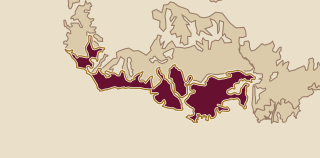
Canelones is the largest wine-producing department in Uruguay, running inland from Montevideo in a belt of low hills and rolling farmland. The Atlantic Ocean sits close enough to regulate temperature: days are warm enough to ripen Tannat fully, but nights cool quickly, so the grape builds aromatic concentration and holds its acidity rather than collapsing into pure weight.
Toscanini's two sites, Paso Cuello and Canelón Chico, share this thermal rhythm. The label carries no protected appellation or designated origin, as Uruguay's wine law does not operate through the same classification structures found in France or Spain. Wines are labelled by grape and tier, and Canelones fruit character reaches the glass without a formal hierarchy to name it.
In the cellar
Vineyards and cellar
Hand harvest and a yield ceiling of under six tonnes per hectare apply estate-wide. Leaf-thinning through the growing season opens the canopy, improving fruit development and keeping humidity low. Only grapes grown on the estate's own 90 hectares go into the wines.
In the cellar, the philosophy is to intervene as little as possible. Fermentation temperatures are carefully managed, and the aim is to carry the grape's character through to the bottle rather than correct or supplement it.
Wines to know
The range in view
The range is anchored by Tannat at three levels, supported by a roster of French red varieties and three whites.
Gran Tannat Premium is the top expression. After 22-plus days of maceration and 18 months in oak, the wine shows inky purple colour, concentrated aromatics of black cherry, plum, blackcurrant, and blackberry, and a palate carrying chocolate, coffee, vanilla, and oak. Tannin is firm and layered; acidity threads through and gives the wine length beyond the initial weight.
A useful way in
A bottle to begin with
Start with the Gran Tannat Premium. It carries everything the estate does in concentrated form: the yield-managed Canelones fruit, the 22-day maceration, the concrete vat malolactic, and 18 months in barrel. In the glass, it is inky, aromatic, and built for food: black cherry and plum upfront, dark chocolate and coffee across the palate, firm tannin that holds its shape through the finish, and enough acidity to cut through the weight. This is Tannat made at full commitment, and it shows every choice Toscanini has made since the 1982 replanting in a single glass.