
Why it matters
The producer
Before Trizanne Barnard had her own label, she had Robert Parker's informal verdict. Her debut vintage at Anwilka in 2005, the first she made as head winemaker there, was described by Parker as the best South African red wine he had ever tasted. The wine was never officially scored. Barnard had been in the job for one harvest.
She launched Trizanne Signature Wines three years later, in 2008, and the label she built does not look like a cautious follow-up. There is no home estate, no single appellation, no single grape. Barnard sources fruit from two regions that sit at opposite ends of the Cape's climate range and makes the wines herself, working with purchased parcels rather than owned vineyards.
Place and vineyards
Where the wines begin
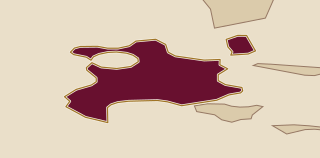
Elim is a ward within the Cape South Coast Wine of Origin region, roughly 200 kilometres southeast of Cape Town. The Atlantic Ocean sits close enough that the wind off it shapes the growing season: temperatures stay low, ripening is slow, and heatwaves are rare. A long, cool summer builds aromatic complexity in Sauvignon Blanc and Sémillon without the loss of acidity that faster-ripening conditions produce. The proximity to the ocean leaves a saline character in the wines, a quality found across multiple Elim producers.
Swartland is inland, north of Cape Town, and the conditions there are a different conversation entirely. The region is hot and dry, with low rainfall and a growing season that suits Syrah. Where Elim produces whites defined by freshness and mineral lift, Swartland produces reds with warmth, body, and darker fruit.
In the cellar
Vineyards and cellar
Barnard works without estate vineyards. She selects individual parcels in Elim and Swartland, buys the fruit, and makes the wines herself. The Seascape Range carries the single-vineyard designation: each bottle comes from one identified parcel rather than a blend across sites. The TSW Range is the entry-level expression of the same geographic thinking.
In Elim, the long ripening season without heatwaves is the key condition. It provides ideal conditions for developing complex wines. In Swartland, Syrah responds to the heat and low rainfall with darker, more concentrated fruit.
Wines to know
The range in view
The two ranges share a geographic logic but occupy different positions in the bottle hierarchy.
The Seascape Range is the premium tier, built around single-vineyard Elim sites on the Cape South Coast. The white wines here are Sauvignon Blanc and Sémillon from parcels where Atlantic exposure and a slow ripening season produce aromatic lift, saline mineral character, and a windswept quality that distinguishes them from warmer-climate South African whites. These are wines with a long cool season behind them: the texture is firm, the aromatics are defined, and the salinity sits in the mid-palate.
A useful way in
A bottle to begin with
The Seascape Elim Sauvignon Blanc is the bottle to open first. It shows what Barnard came south for: a cool, ocean-facing parcel where Atlantic wind and a long season produce Sauvignon Blanc with genuine saline mineral character and aromatic definition that the Cape's warmer appellations do not produce. The wine is firm and fresh, with the coastal salinity present as a mid-palate texture, bright acidity carrying the finish, and none of the tropical broadness that warmer South African Sauvignon often carries.