
Why it matters
The producer
Rita and Virgilio bought a property in Suvereto in 1984 because they wanted somewhere quiet to live. The land came with vines. They planted more, without a plan, without a négociant relationship, without any ambition beyond the modest satisfaction of growing things. That is the starting point for one of the most discussed Super Tuscan estates in the world.
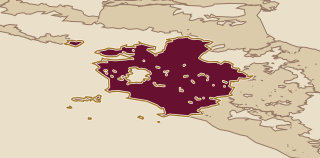
Suvereto is a medieval hill town in the Val di Cornia, on the Tuscan coast roughly 100 metres above sea level. The estate sits in a zone where clay soils and proximity to the Tyrrhenian Sea push Cabernet and Merlot toward generous, even ripening. Those two facts, terrain and maritime air, shaped the red wines from the beginning. Redigaffi, the flagship, is a 100% Merlot. Giusto di Notri is a Cabernet-based blend. The estate also makes Perlato del Bosco in both white and red versions. Total annual output runs to approximately 220,000 bottles. The estate is led today by Stefano Frascolla.
Place and vineyards
Where the wines begin
The Val di Cornia sits between the hills above Suvereto and the Tyrrhenian coast, far enough inland to avoid salt air but close enough to feel the moderating effect of the sea. Elevation at approximately 100 metres holds summer temperatures down and slows ripening enough to preserve acidity in the fruit. The maritime influence is not incidental: Suvereto's terroir is cited specifically for how clay soils and coastal positioning suit Cabernet and Merlot, delivering full colour and concentrated fruit without heat stress. On the label, this translates to wines that sit outside Chianti, outside Montalcino, and outside the traditional Tuscan hierarchy. The Val di Cornia DOC provides the legal address, but the wines are classified as Super Tuscans, made from international varieties in a zone that came to serious critical attention only in the 1990s.
In the cellar
Vineyards and cellar
The estate's production philosophy, committed to uncompromising quality, begins with vineyard management.
In the cellar, the different wines follow different paths. Perlato del Bosco Bianco, the Vermentino, is vinified entirely in stainless steel, preserving the grape's natural aromatics without oak influence. The red wines, Redigaffi in particular, are handled to allow Merlot's concentration and colour depth to come through cleanly. The 9,000-bottle annual production of Redigaffi reflects both the physical limits of the best parcels and the estate's decision to keep the grand vin at a scale where selection remains meaningful.
Wines to know
The range in view
The range has four named wines across two tiers.
Perlato del Bosco Bianco is 100% Vermentino, first released in 1992. It is vinified in stainless steel from the estate's clay-and-pebble plots. Clean, unoaked, with the mineral lift and citrus freshness that Vermentino carries on coastal Tuscan soils. An accessible white wine with a coastal character.
A useful way in
A bottle to begin with
Start with Redigaffi. It is 100% Merlot, made in 9,000 bottles a year from the estate's best parcels. Tasting it places you precisely at the estate's centre: Suvereto clay, maritime Tuscany, Merlot pushed to full phenolic maturity and vinified for maximum colour and aromatic depth. The glass gives deep ruby fruit, chocolate and plum on the nose, and a weighted, texturally generous palate that finishes longer than most coastal Italian reds. There is a direct line between the soil type, the grape choice, the estate's founding moment, and what is in the glass. No other bottle in the range draws those connections as completely.