
Why it matters
The producer
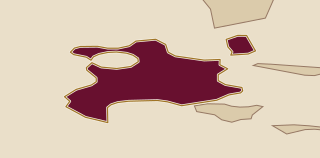
Twee Jonge Gezellen sits in the Tulbagh valley, surrounded by the Winterhoek and Obiekwaberg mountains, and its name is simply what local residents called the farm from the beginning: the place of two young companions. The estate was founded in 1710 by two bachelor cousins, and a farm named for its founders' social status eventually became one of South Africa's oldest continuously operating wine properties. Today it produces almost exclusively under the Krone label, and every bottle is Cap Classique, the South African term for method-traditional sparkling wine.
The physical centre of the estate is Africa's first underground cellar, built to keep bottle-fermenting wines at stable cool temperatures without relying on refrigeration. The cellar underpins the estate's extended lees programmes: Krone Cap Classique matures on lees for a minimum of one year, with premium cuvées running to 16 years and beyond.
Place and vineyards
Where the wines begin
Tulbagh is a valley town in the Western Cape interior, enclosed on three sides by mountain ranges. The valley floor is warm by day, but altitude and airflow from the surrounding peaks cool nights considerably. This temperature shift matters for sparkling wine: grapes need cool nights to retain the acidity and aromatic freshness that drive a good Cap Classique.
The estate's highest parcel, the Kaaimansgat vineyard, climbs to 700 metres above sea level. At that altitude, the diurnal range widens further, the growing season extends, and Chardonnay builds concentration and acidity simultaneously rather than trading one against the other. Kaaimansgat is the origin of the estate's most site-specific Blanc de Blancs expressions. The lower estate sites supply the fruit base for Borealis, the entry-level blended cuvée.
In the cellar
Vineyards and cellar
All harvesting at Krone is done at night. Picking in cool night air preserves the aromatic compounds in Chardonnay and Pinot Noir that heat degrades within hours of being separated from the vine. The grapes arrive at the cellar cold, and cold fermentation continues the process: primary fermentation at low temperature locks in what the night harvest preserved.
After primary fermentation, the blended or single-varietal base wines undergo secondary fermentation in bottle, the defining step of Cap Classique production. The wines then spend their ageing period on lees in the underground cellar. Borealis Cuvée Brut ages for 18 months. Premium cuvées remain on lees far longer, some to 16 years and beyond. Extended lees contact adds biscuity complexity while the estate's cold-fermentation base keeps acidity clean underneath.
Wines to know
The range in view
The Krone range is built around Cap Classique in three broad tiers.
Borealis Cuvée Brut is the estate's blended entry wine, combining Chardonnay and Pinot Noir at 12.16% alcohol, aged 18 months on lees. It opens with oystershell and seabreeze minerality, then moves through bright apple, lime, and white pear over cool acidity. The mousse is composed of tiny, integrated bubbles with a luminous quality. With additional bottle age, biscuity complexity builds over the fruit. A Vintage Cuvée Brut version adds wet stone and polenta to the nose alongside ripe lemon and a gentler mousse; it drinks more directly, in an aperitif register.
A useful way in
A bottle to begin with
Borealis Cuvée Brut is the right first bottle. It is a Chardonnay and Pinot Noir blend aged 18 months on lees in the underground cellar, and it carries the house character in its most accessible form. Oystershell minerality on entry, bright apple and lime through the mid-palate, cool acidity, and a mousse of tiny integrated bubbles. The 18-month lees programme adds biscuity depth that builds further with a year or two in bottle. It is direct without being simple, and it connects the cold-fermentation philosophy and night-harvest freshness in a format that does not require years of cellaring to understand.