
Why it matters
The producer
Union des Vignerons des Côtes-du-Rhône is not one domaine with one cellar door and one estate vineyard. It is a southern Rhône cooperative created by local growers in 1965, now bringing together around 2,000 families. Those families farm the vines, take part in the cooperative’s direction, and supply wines for blending and packaging. A bottle under one of the Union’s labels therefore begins in a broad grower network, then reaches the glass through a shared cellar and blending operation.
The founding decision was organisational but its result is visible on the label. Local growers formed the Union in 1965 so their wines could be handled together through a cooperative structure. Today, members determine strategic guidelines and supply wines to be blended and packaged. Instead of treating the vineyards as anonymous volume, the model gathers grapes and wines from many family-run plots, then turns them into regional and appellation-specific bottles.
Place and vineyards
Where the wines begin
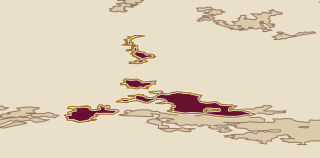
The vineyards spread across roughly 20 Rhône appellations. That matters because an appellation on the label is a more useful clue than the cooperative’s overall size: Côtes-du-Rhône signals the regional level, while a named village or cru narrows the wine to a more specific Rhône address. The Union’s range can therefore move from regional red, white and rosé wines to Côtes-du-Rhône Villages and bottles from Cairanne, Lirac, Vinsobres, Vacqueyras, Gigondas and Châteauneuf-du-Pape.
The southern Rhône’s warm, sunny conditions recur across this range, but the bottles are not one uniform recipe. Grenache, Syrah, Cinsault, Mourvèdre and Viognier grow among the cooperative’s vineyards, and the appellation on the bottle indicates how the grower base has been focused for that wine. Start with the place name before expecting one house style from every label.
In the cellar
Vineyards and cellar
The Union manages about 12,000 hectares through its grower families and works with ten winemaking cellars across the southern Rhône. Multiple cellars allow fruit and wine from different areas to be handled close to their vineyard origin before blending and packaging. The practical consequence is a range built in layers: regional appellations can draw on a wide vineyard base, while named-village and cru bottles can be kept tied to their stated appellation.
Blending is central to the cellar work. Once wines are made, the winemaking team can combine material from different plots and grape varieties into a finished bottling. In a wine such as Les Clefs de l’Enclave Côtes-du-Rhône, Grenache and Syrah are harvested by parcel, gently pressed, fermented in lined concrete for three weeks, then rested in tank after being drawn off the lees. Concrete and tank keep the fruit and spice in view rather than adding an oak flavour.
Wines to know
The range in view
The range begins with red, white and rosé wines under regional Côtes-du-Rhône and IGP designations, then steps up through Côtes-du-Rhône Villages and named villages such as Puyméras, Visan, Valréas, Saint-Pantaléon-les-Vignes and Plan de Dieu. Above these sit crus including Cairanne, Lirac, Vinsobres, Vacqueyras, Gigondas and Châteauneuf-du-Pape. There are also organic ranges, so the label can signal both an appellation and a farming route.
At the regional level, Les Clefs de l’Enclave Côtes-du-Rhône shows the cooperative’s blending approach in a dry red built from Grenache and Syrah. Its fruit-led profile comes with moderate acidity and spice, rather than a prominent oak frame. Higher appellation names do not automatically promise one taste, but they do direct attention from a broad Rhône blend toward a more narrowly defined source of fruit.
A useful way in
A bottle to begin with
Choose Les Clefs de l’Enclave Côtes-du-Rhône Vieilles Vignes. It is a dry red from older vines, made from Grenache and Syrah and bottled under the Union des Vignerons des Côtes-du-Rhône name. The wine brings blackberry and raspberry fruit, pepper, liquorice and southern herbs over a full body, soft tannin and freshening acidity. Its lack of oak ageing keeps the glass focused on fruit and spice, while the Côtes-du-Rhône appellation shows how the Union turns a wide grower network into a specific regional bottle.