
Why it matters
The producer
The Pizzolo family had owned land in Abruzzo for years before they turned to wine. In 1998 they began restoring an old vineyard on the property, and by the early 2000s the estate was bottling under the Valle Reale name. The grapes are three that Abruzzo has built its DOC framework around: Montepulciano d'Abruzzo for red, Cerasuolo d'Abruzzo for rosato, and Trebbiano d'Abruzzo for white.
What changed Valle Reale's direction was a decision in 2007 to abandon commercial yeasts entirely. Every wine since that year has fermented on indigenous microbes cultivated from the estate's own vineyards. The Pizzolos do not describe this as a return to tradition. They frame it more plainly: leave the aromatic profile of the wine to the land, not the laboratory.
Place and vineyards
Where the wines begin
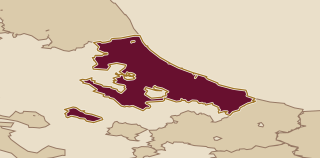
Abruzzo sits on the central Adriatic spine of Italy, running from the Gran Sasso massif down to the coast. The region is warm enough to ripen Montepulciano fully but high enough in its inland valleys to preserve acidity through a long growing season. Montepulciano d'Abruzzo DOC shows deep ruby colour with purple highlights, floral and red-berry aromatics, earthy undertones, tannins, freshness, and mineral characteristics.
Valle Reale's Trebbiano vineyards face south at between 150 and 350 metres, on clay and sandy soils overlaid with limestone. The altitude delays ripening enough to keep aromatics concentrated rather than blowsy, and the limestone beneath the clay introduces a mineral character that shows on the finish. The DOC labelling across all three varieties places the estate firmly within the central Abruzzo production zone, with Montepulciano d'Abruzzo DOC as the regulatory home for both the parcel wines and the estate red.
In the cellar
Vineyards and cellar
The five named parcels are farmed with the intention of separate vinification rather than blending. The Sant'Eusanio parcel produces the estate's flagship Montepulciano, harvested for maximum aromatic lift and parcel specificity. Trebbiano yields are held to 4.4 tons per acre, below the DOC ceiling of 5.6 tons, a decision that concentrates floral aromatics and deepens the mineral character on the palate.
In the cellar, indigenous yeast fermentation governs every wine since 2007. No commercial yeast cultures are added. Fermentation begins when the wild populations present on the grape skins and in the winery environment reach sufficient numbers, and the pied de cuve method helps initiate this without synthetic intervention. The winemaking philosophy is stated plainly on the estate's own materials: leave to nature the task of establishing the wine's aromatic profile. That extends to minimal additions throughout the process.
Wines to know
The range in view
The range is built across three colours and two tiers. The DOC-level Montepulciano d'Abruzzo, Cerasuolo d'Abruzzo, and Trebbiano d'Abruzzo form the estate entry tier: regionally labelled, made for drinking within a few years, and showing the character of the indigenous yeast programme without the parcel specificity of the single-vineyard wines.
The Montepulciano d'Abruzzo DOC opens with deep ruby colour and purple highlights, with floral and red-berry aromatics and earthy undertones. The palate delivers fine tannins, freshness, and a mineral persistence that runs longer than the price suggests.
A useful way in
A bottle to begin with
Start with the Sant'Eusanio Montepulciano d'Abruzzo. It is a single-parcel red from a named cru, fermented on indigenous yeasts, and it carries the clearest argument for what Valle Reale is doing differently from a standard DOC Montepulciano. The nose is aromatic and precise: wild strawberry, dark cherry, Alpine herbs, a faint tobacco note. The palate is crunchy and mineral rather than dense or jammy, with a bright acidity that keeps the fruit alive through the finish and a crushed-stone note that lingers after the fruit fades. It is not a big red. It is a specific one, and that specificity is the point of picking up a Valle Reale bottle over any other Montepulciano d'Abruzzo.