
Why it matters
The producer
In 1998, the Pizzolo family found a neglected Montepulciano vineyard on land they already owned near the town of Popoli in Abruzzo, and decided to bring it back. That decision became Valle Reale: a 46-hectare estate across five named vineyards, growing only two native Abruzzo grapes, Montepulciano and Trebbiano, at elevations between 350 and 500 metres in the mountains of central Italy.
What makes the estate worth knowing is not its size but its internal logic. Each of the five vineyards, Popoli, San Calisto, Sant'Eusanio, Capestrano, and The Convent, sits at a different altitude, on different soils, and ripens weeks apart from the others. The estate treats them as distinct addresses rather than interchangeable parcels, and the wines follow accordingly: fragrant and high-acid from the high-elevation pebbly ground, dense and concentrated from the warm clay. Every wine ferments with the wild yeasts of the vineyard it came from, a commitment the estate has held without exception since 2007.
Place and vineyards
Where the wines begin
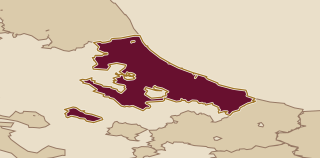
Abruzzo runs down the central Apennine spine of Italy, facing the Adriatic to the east. It is a region of altitude, cold winters, and mountain air, and those conditions show in the grapes: Montepulciano here holds acidity more readily than in warmer southern regions, and the harvest window stretches late into autumn.
Valle Reale's vineyards face southeast along a plain at 350 metres, with the Majella and Morrone mountains directly to the north. Cold air descends from the Gran Sasso massif and slows ripening at the home vineyard in Popoli, pushing harvest into early November. Higher up, at Sant'Eusanio near 500 metres, the pine woods hold the chill longer and the day-to-night temperature swings widen. At Capestrano, the opposite: the vineyard looks out over the Plain of Ofena, a depression the locals call the oven of Abruzzo, and the grapes there ripen two to three weeks ahead of Popoli on heavier clay.
In the cellar
Vineyards and cellar
San Calisto is the founding parcel, planted 1960, trained in the Abruzzo arbours system, and still farmed as the estate's genetic source. It produces estate-level Montepulciano.
Popoli, the home vineyard, faces southeast at 350 metres. Cold air from the Gran Sasso slows the growing season and delays harvest to early November. The vineyard stands in front of a ruined grotto-cellar used by Benedictine monks for wine production and storage from the 1300s.
Wines to know
The range in view
Valle Reale makes red, white, and rosé Abruzzo wines from Montepulciano and Trebbiano only. No international varieties appear in the range.
The Montepulciano d'Abruzzo wines divide by vineyard. The Popoli and San Calisto bottlings represent the estate's home ground: cooler air, slower ripening, harvest in early November, wines with a longer growing-season arc. At the top of the elevation range, the Vigneto Sant'Eusanio Montepulciano d'Abruzzo, from two hectares of pebbly soil at nearly 500 metres, produces Montepulciano with fine character, acidity, fragrance, and phenolic maturity even in powerful vintages. Capestrano and The Convent Montepulciano carry more weight. The clay soils and warmer exposure deliver concentration and a denser mid-palate, ripening two to three weeks before the mountain parcels.
A useful way in
A bottle to begin with
Vigneto Sant'Eusanio Montepulciano d'Abruzzo. This is the bottle that shows what altitude, poor soil, and wild fermentation do to a grape that can easily run toward weight and softness in warmer ground. The vineyard is two hectares at nearly 500 metres in pine woods, planted in 2002 on pebbly free-draining soil. Fermentation uses the indigenous yeasts of the parcel, cultivated through the estate's pied de cuve method. The wine is fragrant, high-acid, and fine in its tannin character: dark cherry and herb aromatics, a sustained acid line through the palate, and a clean finish without heaviness.