
Why it matters
The producer
Sara Pérez and René Barbier Fils were both raised inside two of the families that rebuilt Priorat in the 1990s. Her father José Luis Pérez founded Mas Martinet; his father René Barbier founded Clos Mogador. In 1999, the two of them chose Montsant, the appellation that rings Priorat on three sides, and built Venus La Universal there. It was not a consolation prize. Montsant shares Priorat's llicorellas geology on its steeper slopes, costs far less to farm, and gave them room to make the project their own.
Sara Pérez trained as an oenologist and took over the running of Mas Martinet in 2001. Venus is her and René's separate estate: 4 hectares across five parcels in Falset, farmed biodynamically with horse ploughing and plant infusions in place of pesticides or synthetic fertilisers. The declared intention behind the winery is to interpret femininity through wine. In practice, that translates into lower alcohol, aromatic lift, and earthy complexity drawn from Garnatxa and old local varieties, rather than the extracted power that defined Priorat's early reputation.
Place and vineyards
Where the wines begin
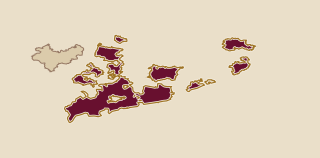
Falset sits in the Montsant DO, a ring-shaped appellation encircling Priorat in southern Catalonia. The two zones share geology: llicorellas, the local name for schist and red slate, runs through the steeper parcels in both appellations and gives wines their characteristic mineral edge. Where Priorat built its name on concentrated, high-alcohol reds from very old Garnatxa vines, Montsant allows a wider range of soils, elevations, and grape-to-bottle ratios, which is precisely what Venus La Universal takes advantage of.
The five parcels on steep slopes face north, which moderates temperature and slows ripening relative to south-facing sites at similar altitude. That orientation, combined with soil differentiation across parcels, shapes which wine each grape becomes: cooler, slower development leads to brighter acidity and more herbal aromatic lift.
In the cellar
Vineyards and cellar
Biodynamic farming at Venus La Universal means horse ploughing between the vine rows on steep slopes and treating the vines with plant-based infusions rather than synthetic inputs. No pesticides, no synthetic fertilisers. Organic certification came in 2009; biodynamic practice extends that framework into a seasonal rhythm tied to lunar and agricultural cycles.
In the cellar, Sara Pérez ferments with indigenous yeasts, which means fermentation starts and progresses on its own schedule rather than at the prompt of a commercial culture. Whole bunches go into fermentation for many of the wines, which keeps the stems in contact with the juice during extraction and adds a textural and aromatic dimension, typically more herbal, slightly more tannic through the stem, and with a different oxygen movement than fully destemmed fermentation.
Wines to know
The range in view
The estate's range divides into two tiers. The Dido wines are the more accessible level, differentiated by soil: decomposed granite for the red, limestone for the white, a mixed granite-clay-limestone-sand blend for the rosé. The Venus wines sit on the clay-calcareous parcels, which ripen slowly and build complexity differently from the granite Dido parcels.
Garnatxa runs through every format. Garnatxa Negra leads the reds; Garnatxa Blanca appears in the whites; all three Garnatxa colours (Negra, Blanca, and Gris) combine in the Dido La Solució Rosa alongside Macabeu, Ull de Llebre (the local name for Tempranillo), and Cariñena. That six-variety blend is unusual even by Catalan standards, where multi-variety rosés have a long tradition.
A useful way in
A bottle to begin with
Dido La Solució Rosa is the right first bottle from this estate. It blends all three Garnatxa colours with Macabeu, old-vine Ull de Llebre, and Cariñena, all from parcels across the Dido soil spectrum: granite, clay-limestone, sand. Grilled peach and orange rind come first; wild thyme and lavender follow; savoury earthiness runs underneath. The wine is light enough for the table but carries enough grip and aromatic wildness to hold attention through a full glass. The 2019 vintage scored 92 points from Decanter.