
Why it matters
The producer
Vercoope does not fit the usual idea of a wine estate. There is no founding family, no single domaine, no château on a hill. It is a federation of cooperatives from seven municipalities across the Vinho Verde region, bottling through one shared facility in Santo Tirso. The member cooperatives draw their fruit from between 4,000 and 5,000 wine growers, and the bottles they produce reach more than 30 countries across five continents.
That scale is real. So is the varietal commitment. Where a producer of this volume might reasonably pivot to international grapes that are easier to sell in export markets, Vercoope has built its range around Alvarinho, Loureiro, and Azal: three indigenous Vinho Verde varieties that require local knowledge to grow well and local context to sell. The sustainability pillar that names indigenous grape preservation is not a marketing line; it describes the architecture of the range.
Place and vineyards
Where the wines begin
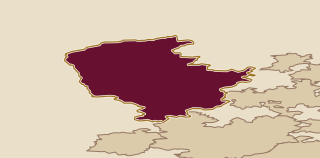
Vinho Verde is a Denominação de Origem Controlada (DOC) in northwest Portugal, stretching across a broad Atlantic corridor between the Douro river to the south and the Spanish border to the north. The region is wet, green, and granite-heavy, with a landscape and this landscape lends the DOC its name: wines labelled Vinho Verde come from vines grown in this green country, where high rainfall and cool Atlantic air slow ripening and preserve acidity in the grapes.
Labels in Vinho Verde follow the DOC rules: a wine may name the grape variety if that variety accounts for 85 percent or more of the blend, or it may carry a sub-zone designation if the fruit qualifies. Via Latina Alvarinho names both the brand and the grape, placing it within the broader Vinho Verde DOC.
In the cellar
Vineyards and cellar
The vineyards feeding Vercoope are farmed by 4,000 to 5,000 individual growers across seven municipalities. The Atlantic climate means canopy management matters: without careful vine training and pruning, the wet northwest Portuguese summers encourage disease pressure and dilute the fruit. The traditional pergola training systems common in the region lift the canopy away from the damp ground, improving airflow and helping grapes ripen cleanly despite the rainfall.
Cellar protocols are not detailed in confirmed sources. No barrel ageing, extended lees contact, or malolactic fermentation practices are documented for the range. The wines in the range, particularly the Alvarinho, show the character of grapes harvested for aromatic clarity and natural acidity rather than for extraction or oak development.
Wines to know
The range in view
The range is built on three indigenous grapes. Via Latina Alvarinho is the anchor: a monovarietal white from Alvarinho, the grape most associated with the Monção e Melgaço sub-zone, though the labelling here falls under the broader Vinho Verde DOC. In its youth it is floral and citric, with a mineral thread running through fresh lime and jasmine. The wine has enough weight and acidity to change over time, and with a few years it moves from that citric brightness toward honey, almond, and pine nut.
A Loureiro-Alvarinho blend balances the two varieties at roughly 70 to 30. Loureiro brings floral aromatics and a lighter, more transparent body. Alvarinho fills out the mid-palate and deepens the aromatic register. The blend is designed to be approachable earlier than a straight Alvarinho and broader in its appeal.