
Why it matters
The producer
Vérité Estate makes three Bordeaux-variety red wines from Sonoma County, and nothing else. No second label, no white wine, no entry-level range. The proposition is simple and expensive to maintain: take 54 individual vineyard blocks spread across four different Sonoma appellations, ferment each one separately, blend from more than a hundred different lots, and compose three wines that each carry a different grape at their centre.
The winemaker is Pierre Seillan, born in Lauzun in the Lot-et-Garonne in 1950, trained across Bordeaux appellations, and recruited to California by Jess Jackson in the mid-1990s. Seillan brought a right-bank sensibility to a county known primarily for Cabernet Sauvignon: his concept of micro-cru, the principle that each individual parcel carries a distinct soil message worth capturing separately, drives every decision in vineyard and cellar. His daughter Hélène co-directs winemaking today, carrying the method forward across a second generation.
Place and vineyards
Where the wines begin
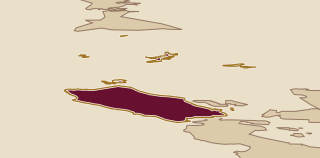
Sonoma County sits north of San Francisco, separated from Napa Valley by the Mayacamas Range. Vérité draws from four of its appellations, each with a different climate signature and soil type, and treats them not as a collective Sonoma address but as a library of distinct sites.
Knights Valley, the warmest of the four, shares a boundary with Napa and suits Cabernet Sauvignon's need for long, even ripening. Alexander Valley, also warm, sits along the Russian River corridor and provides Cabernet with dark fruit and body. Chalk Hill takes its name from volcanic ash soils. Bennett Valley, the coolest, sits at higher elevation with marine influence from nearby gaps in the coastal hills; Cabernet Franc planted here ripens later and retains a tighter, more perfumed character than the variety typically shows in warmer California growing areas.
In the cellar
Vineyards and cellar
Each of the 54 blocks is harvested, transported, and fermented independently. The decision to keep blocks separate through fermentation is expensive in tank space and labour, but it preserves every parcel's individual character through to the blending stage. By the time Seillan sits down to compose each of the three wines, he is working with more than a hundred individual lots.
Blending at this scale is not an exercise in consistency. A lot that appears weak or excessively acidic in isolation may bring balance to the final wine when combined with denser, riper material from a different block. Seillan's phrase for this is direct: he wants to capture the real message of the soil, and that message only becomes legible when the individual components are evaluated against each other.
Wines to know
The range in view
The range is three wines, each named in French, each built around one of the principal Bordeaux red varieties.
La Joie leads with Cabernet Sauvignon from Knights Valley and Alexander Valley blocks. The wine is the most structured of the three: dark blackcurrant and plum fruit, firm and slow-resolving tannins, and a body that rewards several years of bottle ageing. It is the wine most legible to drinkers already familiar with Napa Cabernet, though the Knights Valley source gives it a slightly cooler, more savoury character than the valley-floor style that dominates Napa's reputation.