
Why it matters
The producer
Vietti sits in Castiglione Falletto, a hilltop village that looks out over the Barolo production zone from its centre. Carlo Vietti founded the estate there around 1873, and four generations of the family have worked the same address since. The estate makes Nebbiolo-based Barolo and Barbaresco, Barbera in two appellations, Moscato d'Asti, and Roero Arneis, but two decisions from the 1960s give the range its character: in 1961, winemaker Alfredo Currado bottled a single-vineyard Barolo from Rocche di Castiglione at a time when no one was doing it, and in 1967, the estate produced the first commercial pure-varietal Arneis, reviving a white grape that had nearly vanished from Piedmont.
Currado joined the estate in 1960 and changed the direction of the cellar almost immediately. Before his arrival, Barolo was blended from multiple sources and sold without vineyard attribution. Currado's insistence on separating what each site produced is now the standard model across the appellation. The estate today runs four named Barolo crus alongside its full range, and Barbera, perhaps unexpectedly, accounts for half of total production.
Place and vineyards
Where the wines begin
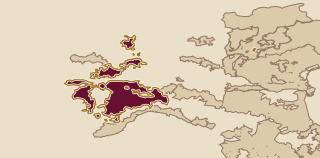
Castiglione Falletto is a commune in the Langhe, the chain of hills in southern Piedmont that runs south from Alba toward the Ligurian Alps. The Barolo DOCG surrounds the village and its neighbours; the appellation name, Barolo, comes from a village to the southwest. Nebbiolo is the only grape permitted in Barolo and Barbaresco, the two serious red appellations anchoring this part of Piedmont.
The estate's most powerful cru sits outside its home village. Lazzarito is a vineyard in Serralunga d'Alba, a commune at the southeastern edge of the Barolo zone known for compact, calcareous soils and wines with notably firm tannin and long cellaring requirements. That address changes the label: Barolo Lazzarito carries the Serralunga name, and its drink window, opening from 2026 on the 2019 vintage, reflects how the place handles Nebbiolo.
In the cellar
Vineyards and cellar
Nebbiolo wines age in large botti, the traditional large-format Slavonian oak casks that impart minimal oak flavour while allowing slow oxidation and gradual tannin softening. The format suits Nebbiolo's natural grip: the large surface-to-volume ratio of barriques would add detectable oak character that competes with the grape's own aromatic profile. Lazzarito spends 30 months in large cask before bottling.
Barbera takes a different path. It spends 6 to 8 months in barriques, giving the grape a rounder, more forward profile with slightly more oak presence than the Nebbiolo wines. The difference in vessel matches the difference in purpose: Barbera is the earlier-drinking, higher-volume part of the range.
Wines to know
The range in view
The range divides across three tiers by grape and aging trajectory.
At the lighter, earlier-drinking end: Moscato d'Asti from 100% Moscato Bianco at 5% alcohol, lightly sparkling and sweet, with peach, apricot, pear, rose petal and fresh ginger, its sweetness lifted by fresh acidity. Roero Arneis sits alongside it in weight if not in style: dry, medium-bodied, with citrus, melon and fresh flowers on the nose, a mineral thread through the mid-palate, and an almond note on the finish. Both bottles are for drinking young.
A useful way in
A bottle to begin with
Start with Roero Arneis. It is 100% Arneis from the Roero zone, fermented cold in steel and aged on lees with no oak, and it delivers what the estate does with a white grape that nearly disappeared: clean, citrus-forward, medium-bodied, dry, with a mineral thread and an almond finish that no other common Italian white quite matches. It does not require any knowledge of Barolo to appreciate. It also carries the date 1967 behind it, the year Vietti produced the first commercial bottle of this variety, which means the glass has a small piece of regional history in it.