
Why it matters
The producer
Vignobles Dom Brial gathers vineyards rather than presenting one enclosed estate. Its Baixas cellar brings together roughly 200 member growers, so the range can move from Côtes du Roussillon reds to Muscat and long-aged Rivesaltes. Founded in 1923, it was named for Dom Brial, an 18th-century Benedictine monk and historian who supported the village community. That collective structure is visible on the labels: Dom Brial sits beside Château Les Pins and the rosé Rozy collection rather than reducing Roussillon to one grape or one wine style.
Dom Brial’s recent story is a change inside a long-running cooperative. It joined the Committed Winegrowers programme in 2007, then released its first organic range in 2021. Organic wine now accounts for more than 10% of total production. The consequence is practical rather than decorative: part of a wide Baixas range is now presented through organic farming, while the cellar still works with the same broad set of Roussillon categories—red, white, rosé and natural sweet wine.
Place and vineyards
Where the wines begin
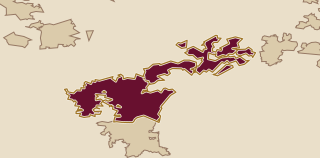
Baixas lies in Roussillon, in France’s Mediterranean south. Here, Côtes du Roussillon and Côtes du Roussillon-Villages frame dry red wines, while Rivesaltes and Muscat de Rivesaltes carry the region’s natural sweet-wine tradition. The distinction matters at the table: a Côtes du Roussillon-Villages label such as Château Les Pins is a red-wine appellation, whereas Muscat de Rivesaltes signals a sweet style. Dom Brial’s range makes that regional split tangible through bottles rather than treating Roussillon as a single taste.
In the cellar
Vineyards and cellar
A cooperative of this size has to turn many growers’ fruit into recognisable labels. Dom Brial does that by grouping wines into three collections: Dom Brial, Château Les Pins and Rozy. The farming commitments introduced since 2007, and the organic range launched in 2021, give the vineyard work a formal framework; the labels then separate wine styles and appellations. For a concrete cellar example, Château Les Pins 2020 spent one year in oak barrels, divided equally among new barrels and barrels one and two years old, adding oak character to its fruit.
Wines to know
The range in view
The dry-wine range begins with Mediterranean red blends, where Syrah, Grenache, Mourvèdre and Carignan supply body, fruit and tannin in different proportions. Côtes Catalanes, Côtes du Roussillon and Côtes du Roussillon-Villages appear across red, white and rosé bottles, including Les Camines, L’Etreinte, Crest Petit, Mirade and Rozy. Château Les Pins is the more site-specific collection, with red, white, amber and Muscat bottlings.
Natural sweet wine is the other substantial branch. Muscat de Rivesaltes offers aromatic sweetness, while Rivesaltes appears as Grenat, Ambré, Tuilé and older Grande Réserve wines. The latter include vintages such as 1969, 1983, 1986 and 1989, so sweetness and age are part of the range architecture, not an afterthought beside the dry reds.
A useful way in
A bottle to begin with
Start with Château Les Pins 2020, a Côtes du Roussillon-Villages red from Baixas. It connects a named château within the cooperative to a clear appellation and a stated blend of Syrah, Grenache and Mourvèdre. Its year in oak—one-third new, one-third one year old and one-third two years old—explains the oak character beside blackberry, plum, cocoa and tobacco. The dry, full-bodied palate and savoury black-olive finish make it a direct introduction to Dom Brial’s red-wine work; it also leaves the sweet Rivesaltes and Muscat bottles free to do a different job.