
Why it matters
The producer
The modern name is closely tied to André Lurton, who lived from 1924 to 2019, and to Jacques Lurton, an oenologist trained in Bordeaux in 1983. Jacques spent decades working in Australia before returning to lead the family business; that international experience sits beside a firmly Bordeaux range of château-labelled wines and grape blends.
Château Bonnet became the operational foundation of André Lurton’s career through measurable growth. He expanded it from approximately 50 hectares to more than 300 hectares by the 1990s, a change that turned one estate into a substantial source of both white and red Bordeaux. Under his leadership, the company produced about four million bottles annually, making the Château Bonnet label the practical centre of a much larger family operation rather than a small side estate.
Place and vineyards
Where the wines begin
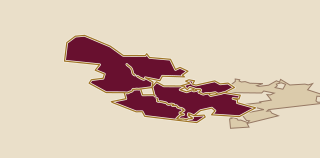
Bordeaux is the frame for the whole portfolio, while Pessac-Léognan is the place-name to watch on Château La Louvière. André Lurton helped establish Pessac-Léognan as a distinct appellation, and its appearance on the La Louvière label separates that wine from the broader Château Bonnet bottlings. The distinction matters in the glass: Bonnet is the estate’s wide-reaching foundation, while La Louvière is presented through a named Bordeaux appellation and vintage-specific blend.
The supplied record does not attach soil types, slopes or named parcels to these bottles. The firmer guide is therefore the label and blend: Château Bonnet white 2024 centres on Sauvignon Blanc, while its red 2021 combines Cabernet and Merlot; Château La Louvière red changes its Merlot-Cabernet balance between 2020 and 2022. Those named sites and grape proportions provide the clearest route to choosing among the wines.
In the cellar
Vineyards and cellar
At Château Bonnet, the documented vineyard work begins with crop and canopy decisions, which affect the grapes arriving at the cellar. Temperature-controlled fermentation then offers control over how those grapes become wine. This matters most when reading the range by style: the white is a Sauvignon Blanc-led blend described as fresh and bright, while the red is built around Cabernet and Merlot with tannin structure.
The cellar influence becomes more explicit with Château Bonnet Réserve red and Château La Louvière red 2020. The Réserve has separate tasting material that notes tannin and oak, setting it apart from the standard Bonnet red. La Louvière 2020 also has documented oak ageing, so its Merlot-Cabernet fruit is accompanied by an overt barrel-aged element rather than being described simply as a young red Bordeaux.
Wines to know
The range in view
Château Bonnet provides the broadest introduction to the range. The 2024 white is 80% Sauvignon Blanc, 14% Colombard and 6% Sémillon: a pale yellow wine with subtle green reflections and a fresh, bright profile. The 2021 red moves to 60% Cabernet and 40% Merlot, with tannin as a defining structural feature. The red Réserve takes the Bonnet name in a more oak-marked direction, with both tannin and oak noted in its tasting record.
Château La Louvière red is the Pessac-Léognan branch of the range. Its 2020 blend is 80% Merlot and 20% Cabernet, with oak ageing documented. The 2022 shifts to 70% Merlot and 30% Cabernet; fruit character and ageing potential are noted for that vintage. The two bottles should not be treated as interchangeable: the ratio changes, and the vintage remains part of the wine’s shape.
A useful way in
A bottle to begin with
Start with Château Bonnet white 2024. It is the clearest concise expression of the producer’s Bordeaux scale and blend-making: 80% Sauvignon Blanc, supported by Colombard and Sémillon, from the estate André Lurton developed into the family’s large foundation. Pour it for its pale yellow colour, subtle green reflections and fresh, bright dry profile. It comes first because its label, grape make-up and direct style make the family’s everyday Bordeaux work easy to read before moving to tannic reds or oak-aged Pessac-Léognan.