
Why it matters
The producer
Villa di Geggiano sits at the southern end of Chianti Classico, where the appellation runs out of room before the landscape shifts toward the Crete Senesi. The Bianchi Bandinelli family has farmed this specific ground since 1527, and that continuity shapes everything about the estate: modest scale, organic farming, and a Sangiovese-led range that stays close to traditional Tuscan winemaking rather than chasing a more international style.
Brothers Alessandro and Andrea Boscu Bianchi Bandinelli now manage the estate. Production sits at around 35,000 bottles, which is small enough that every bottle carries weight. The farming is organic, with biodiversity preservation stated as a core commitment rather than an afterthought.
Place and vineyards
Where the wines begin
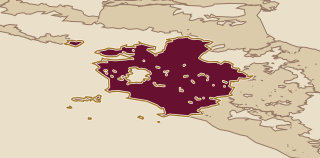
Castelnuovo Berardenga is the southernmost commune in the Chianti Classico zone, and Villa di Geggiano's vineyards occupy the southernmost reach within that commune. In a DOCG that runs roughly 70 kilometres from Florence to Siena, position within that corridor matters. The southern end is warmer and more open than the cooler, higher elevations around Panzano or Radda, and Sangiovese responds with riper, fuller fruit and slightly softer tannin compared to the leaner, more acid-driven character of the central and northern zones.
The label reads Chianti Classico, which places the wine inside the black rooster consortium's appellation and commits the estate to the DOCG's Sangiovese-led rules. At the southernmost address within that appellation, the fruit arrives with more weight, and the winemaking choices at Geggiano, stainless steel rather than large wooden vats, measured oak contact rather than heavy extraction, are designed to keep that ripe character from tipping into excess.
In the cellar
Vineyards and cellar
The Chianti Classico goes through stainless-steel fermentation over 16 days at 28 degrees Celsius. Stainless steel at a controlled temperature preserves the primary fruit character of Sangiovese: the cherry, dried herb, and floral lift that the grape throws when it is not pushed through very high temperatures or long maceration. Malolactic fermentation follows primary fermentation, converting the sharpest malic acid to softer lactic acid and rounding the wine's mid-palate without eliminating the backbone.
After fermentation, the wine moves into 500-litre French-oak tonneaux for at least 18 months. With 10% new oak, the barrel contact is present but not dominant. At this size and new-oak ratio, the tonneaux add a faint spice note without replacing the grape's character with oak flavour. Bottle maturation of at least four months follows before release, letting the wine's components settle into each other.
Wines to know
The range in view
The range centres on three wines, with Chianti Classico at the base, Chianti Classico Riserva above it, and Ai Lecci as a single-site Sangiovese.
The Chianti Classico is 100% Sangiovese (confirmed for the 2018 vintage) and follows the stainless-and-tonneaux method described above. It is the entry into the estate's Sangiovese: medium-bodied, with red fruit, dried herb, and firm but not aggressive tannin from the grape and the short oak exposure.
A useful way in
A bottle to begin with
Start with the Chianti Classico. It is 100% Sangiovese from the southernmost vineyards in the appellation, fermented in stainless steel and aged 18 months in 500-litre tonneaux with 10% new oak. The wine is medium-full, dry, and built around the classic Sangiovese fruit profile: red cherry, dried herb, a faint floral lift, dusty tannin, and firm acidity on the finish. There is no oak character dominating the glass. The fruit and the tannin are both from the grape and the place, not the cellar.