
Why it matters
The producer
Villa Sandi operates from a 1622 Palladian villa in the Treviso hills, where the Moretti Polegato family both lives and makes wine. The villa is not a showpiece attached to a separate industrial operation. It is the working headquarters, and three underground galleries running more than 1.5 kilometres beneath the building are the ageing cellars.
The family has been farming grapes since the early 1920s, when Mario Polegato bought vineyards and entered the wine market. In the late 1970s, his descendants bought the derelict villa and began a restoration that would eventually turn it into one of the more distinctive addresses in the Veneto sparkling wine world. Giancarlo Moretti Polegato now leads the winery, and his children Diva and Leonardo have joined the operation, bringing the family to four generations in wine.
Place and vineyards
Where the wines begin
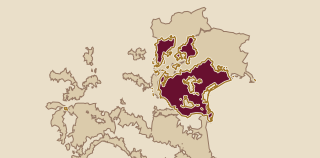
Prosecco grows in a long strip of northeastern Veneto running from Conegliano west to Valdobbiadene. The broader DOC covers a wide plain; the Valdobbiadene DOCG sits at the western end, where the pre-Alps push the vines onto hillsides with sharper sun exposure and better drainage. Within Valdobbiadene, Cartizze is a 107-hectare sub-zone on a single steep hill above the village of San Pietro di Barbozza. It is the most specific Glera address in the whole Prosecco system.
The Cartizze hill rises sharply and sits above the morning fog that collects in the Valdobbiadene valley. The soils are a mixture of sandy moraine and clay left by glacial activity, with good drainage on the steeper slopes. This drainage and the hill's particular exposure slow ripening and extend the growing season, giving the Glera grapes time to build aromatic complexity without gaining excessive sugar.
In the cellar
Vineyards and cellar
Villa Sandi runs six estates across Veneto and Friuli Venezia Giulia. The Valdobbiadene estate provides grapes for the DOCG cru Proseccos. The Crocetta del Montello estates around the villa supply the still reserve wines, Marinali and Còrpore, and the grapes for Opere Trevigiane Metodo Classico. Nervesa della Battaglia grows Glera and Chardonnay on Montello slopes near the Piave.
In the cellar, Prosecco production follows the Charmat method: secondary fermentation in temperature-controlled tanks rather than bottle. For Il Fresco Brut, fermentation runs at 15 to 16 degrees Celsius with selected yeasts. The must is held at zero degrees between batches, and bottling happens in runs rather than in one continuous operation. This preserves freshness across a large production run. Sulphur additions sit at roughly half the legal maximum, a conservative choice that limits oxidation risk without heavy intervention.
Wines to know
The range in view
Il Fresco Brut (Prosecco DOC Treviso) is the entry-level wine, made from Glera, fermented in tank at 15 to 16 degrees Celsius. It carries 12 grams per litre of residual sugar and 5.8 grams per litre of total acidity, with alcohol around 11.5 percent. The bubbles are fine and persistent. White pear, apple blossom and a light green note from the Glera grape; the acidity keeps the sweetness in check and the finish is short and clean.
The Prosecco Superiore DOCG Valdobbiadene crus move up in concentration and hillside character. The grapes come from the sun and wind-exposed Valdobbiadene estate, and the fruit is richer and more aromatic than the Treviso tier.
A useful way in
A bottle to begin with
Cartizze La Rivetta is the bottle to choose. Cartizze is a 107-hectare hill above Valdobbiadene, one of the smallest and most specific Glera appellations in Italy, and Villa Sandi holds what is reported as the largest single parcel on it. The wine is made from those grapes alone, fermented in tank. Ripe peach and apricot on the nose, a soft full mousse in the mouth, with sweetness balanced by the acid line that Glera carries even at full ripeness. It is not a bone-dry sparkling wine. It is a sweet-leaning Prosecco with weight and length. Start here to understand what the Cartizze hill produces and why it has its own appellation.