
Why it matters
The producer
Villa Wolf sits in Wachenheim, a village in the Mittelhaardt, the central belt of the Pfalz where the Haardt mountains block the wet westerlies and the Rhine plain opens flat to the east. The land has been in wine production for close to 250 years. Ernst Loosen, who had already turned the Dr. Loosen estate in the Mosel into one of Germany's most closely watched properties, acquired Villa Wolf in 1996 and applied the same logic he had used on the Mosel: no cultured yeast, no new oak, low intervention in the cellar, and patient ageing in large neutral casks.
Place and vineyards
Where the wines begin
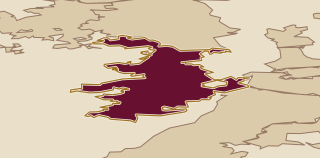
Wachenheim lies in the Mittelhaardt, the section of the Pfalz that runs from Neustadt in the south to Bad Dürkheim in the north. The Haardt range shields the vineyards from Atlantic weather systems, and the Rhine plain to the east draws warmth. The climate is one of the sunniest in Germany, warm enough to ripen Grauburgunder and Pinot Noir reliably while retaining the acidity that keeps dry Riesling from going flat.
The Mittelhaardt sits on a varied geological base. Sandstone, limestone, and loam alternate across the sub-zone, and the variation between plots shapes both the weight and the texture of the wines. Villa Wolf's vineyards draw minerality from the soil composition of Wachenheim's slopes, a quality audible in the Grauburgunder and present as a chalky edge in the dry Riesling. Organic farming since 2014 has allowed cover crops and reduced chemical inputs to feed back into the soil, a change that the estate expects to compound slowly over time.
In the cellar
Vineyards and cellar
Organic farming at Villa Wolf means no synthetic herbicides, pesticides, or fertilisers. Cover crops between rows and natural soil management support vine root depth and encourage the kind of slow, even ripening that translates into more defined fruit in the glass. The vines work harder in organic conditions, which concentrates flavour at lower yields without requiring intervention at harvest.
In the cellar, spontaneous fermentation with ambient yeasts slows the process and builds more layered aromatic development than cultured yeast would produce. Large neutral oak casks are used for fermentation and ageing across the dry whites. They add no oak flavour, but they do allow micro-oxygenation that rounds texture over time without stripping freshness. The Grauburgunder uses a split: half in neutral oak for depth and complexity, half in stainless steel to preserve vibrant fruit and clean acidity. The Pinot Noir spends twelve months in used barriques, which contribute smoky depth and earthy tannin without overwhelming the wine's dark cherry fruit.
Wines to know
The range in view
Villa Wolf's three-wine range maps neatly onto the Pfalz's capacity for dry whites and warm-climate reds.
The Riesling Dry is medium-bodied with peach and stone fruit at the centre and a hint of apricot behind it. Bright acidity gives it grip without adding weight, and the finish stays clean and mineral. This is Pfalz Riesling in its approachable register: fruit-forward and dry, without the austerity of a Mosel Spätlese or the sweetness of an off-dry Kabinett.
A useful way in
A bottle to begin with
Start with the Riesling Dry. It is medium-bodied, dry, and unambiguous: peach and stone fruit, apricot, a clean acid line, a mineralic finish. No residual sweetness, no oak. The bottle shows what the Mittelhaardt does with Riesling under a Loosen cellar philosophy: fruit-forward without being heavy, dry without being austere, and precise enough to hold attention through the glass. It is the right first bottle because it is the clearest expression of what the estate is built to do.