
Why it matters
The producer
Viña Bouchon farms three estates in the Secano Interior, the unirrigated interior of the Maule Valley, where old vines on granitic soils are the argument and the asset. The family's most recognized bottles are País and Sémillon grown without irrigation, from vine blocks that range from 80 to 100 years old. Carignan, classified under the Vigno designation, anchors the upper tier.
The operation is led by the fourth generation: brothers Julio and Juan alongside their sister María. Christian Sepúlveda is Head Winemaker, with earlier vintages at Tabalí in Limarí, Comte Armand in Burgundy, and Felton Road in New Zealand. That breadth of cool-climate and old-vine experience shapes how the cellar handles low-yield fruit from long-established parcels.
Place and vineyards
Where the wines begin
Maule Valley sits south of Santiago in Chile's Valle Central, a broad inland basin running between the Andes and the Coastal Range. The Secano Interior is the dry western slope of that basin, where rainfall is seasonal and irrigation is structurally absent. Soils here are ancient granite, broken down over millennia into free-draining, low-fertility ground that forces vines deep and limits yields without any deliberate intervention.
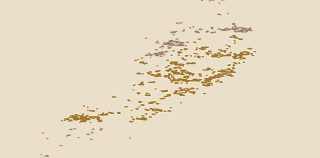
The three Bouchon estates each occupy a distinct part of the valley. Mingre is 45 km from the Pacific at 192 metres, the closest to a true interior address. Batuco is 25 km from the ocean on a coastal property where maritime air moderates the growing season. Santa Rosa sits near the Maule River on alluvial ground with a warmer Mediterranean floor. The label range follows the estates: inland granite for País, coastal maritime for Sémillon, and the river plain for Bordeaux varieties.
In the cellar
Vineyards and cellar
Dry-farming across the three estates is the primary viticultural choice, not a marketing position. In the Secano Interior, there is no supplemental water; vines develop deep root systems over decades to access subsurface moisture through summer.
Old vine management requires low intervention: no irrigation, no aggressive trellis systems on the oldest bush-trained parcels, and minimal canopy manipulation where vine age already self-regulates yield. Selection at harvest on these old blocks is precise because the fruit is irregular and the quantity small.
Wines to know
The range in view
The range is organized across three estates and three main varieties, each with its own farming logic and cellar approach.
J Bouchon País Viejo is the entry and signature. País is one of the oldest grape varieties grown in Chile, brought by Spanish missionaries in the sixteenth century and planted widely before Cabernet Sauvignon arrived. At Bouchon, it comes from Block 30 at Mingre, 100-year-old dry-farmed vines on granite. The wine is pale ruby with medium body, running at 12.5% alcohol. Tannins are moderate and fine-grained rather than grippy, closer in feel to a cool-climate Pinot Noir than to a full-bodied red. Acidity is present throughout. Fruit runs toward cherry, strawberry, and plum, with earthy undertones and a spice finish.
A useful way in
A bottle to begin with
Start with J Bouchon País Viejo. It is a red wine from one of the oldest grape varieties in Chile, grown without irrigation on a 100-year-old block of granite at Mingre, run through the cellar with minimal intervention and released at 12.5% alcohol. The nose is approachable and specific: earth, berries, a little spice. The palate is medium-bodied, bright with acidity, and finishes long and dry with pepper. The tannins are soft enough to drink now, firm enough to hold the wine together over a meal.