
Why it matters
The producer
Manuel Cerdeira spent more than thirty years making wine in Melgaço, the high-altitude subregion at the northern edge of Vinho Verde, before he and his son Luís founded Vinevinu in 2024. The name folds Portuguese and Latin together: vine and vinu, a small statement about local roots and wider ambition.
The producer launched with two wines drawn from opposite ends of the Vinho Verde denomination: Génese, a 100% Alvarinho from Manuel's home ground in Melgaço, and Guri, a coastal blend grown in Requião, a parish in the Barcelos lowlands where Atlantic weather shapes a very different growing season. Vinevinu was not built as a single-appellation house with a second label attached. The two terroirs were the premise from the beginning.
Place and vineyards
Where the wines begin
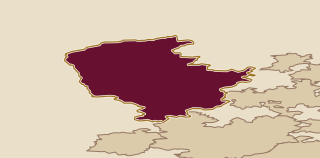
Vinho Verde covers a large tract of northwest Portugal between the Douro and the Minho rivers, and the variation within its legal boundary is wide enough that two bottles labelled Vinho Verde can taste like wines from different countries. The appellation encompasses low-lying coastal zones exposed to constant Atlantic wind and rain, and mountain subregions in the far north where altitude and proximity to Spain produce a cooler, drier growing season with sharper temperature swings between day and night.
Requião, the source of Guri, sits in the Barcelos lowlands near the coast. Atlantic influence dominates: high rainfall, maritime humidity, and a shorter, warmer ripening window that suits grapes with natural sweetness and softer acidity. The wines from the coast read differently from mountain Alvarinho, and Vinevinu's range was designed to make that contrast legible.
In the cellar
Vineyards and cellar
Génese is fermented with indigenous yeasts and aged in contact with fine lees. Indigenous yeast fermentation proceeds more slowly and unpredictably than inoculated fermentation, and it tends to build texture and complexity in the finished wine rather than primary fruit brightness alone. Lees contact adds roundness and volume, softening acidity while extending the mid-palate.
For Guri, the coastal origin at Requião shapes the wine from the ground up: Atlantic maritime conditions produce grapes with natural sweetness alongside acidity, and the wine is made to hold that balance rather than drive toward dryness.
Wines to know
The range in view
Vinevinu currently produces two wines from two geographically opposed terroirs.
Génese is 100% Alvarinho grown in Melgaço at altitude. It is a dry white wine with a medium-intensity yellow colour. The nose is described as deep and complex, the palate as fresh, rounded, and persistent, with balance between acidity and mouth volume and a long finish. Lees contact contributes roundness without masking the mountain Alvarinho's natural drive. Génese carries stated ageing potential, unusual for a Vinho Verde and a consequence of the grape's concentration at altitude combined with the lees-contact framework.
A useful way in
A bottle to begin with
Génese Alvarinho 2024 is the first bottle. It is 100% Alvarinho from high-altitude parcels in Melgaço, fermented on indigenous yeasts and aged on fine lees: three choices that point toward complexity and longevity rather than immediate lightness. The nose delivers peach and honey. The palate is incisive, saline and full, with freshness that keeps the texture from feeling heavy. Acidity and volume hold each other in balance across a long, persistent finish. Génese 2024 received 92 points from James Suckling in its debut year, a score that reflects the depth Manuel Cerdeira's three decades in Melgaço bring to this first bottle under his own label.