
Why it matters
The producer
Staffan and Lil Ottosson run Vingården Stora Boråkra from a manor house built in the 1880s, ten minutes from the naval city of Karlskrona in Blekinge, Sweden's southernmost mainland county. The vineyard is the largest in Blekinge and one of the larger commercial wine estates in Sweden. Nearly everything planted here is Solaris, a white hybrid developed in Germany for disease resistance and reliable ripeness in short northern summers. The portfolio is two wines: a dry still white fermented in stainless steel and a sparkling wine made by secondary fermentation in bottle.
Staffan sits on the board of Svenskt Vin, the Swedish wine industry association, and has spent years training the next generation of Swedish winemakers. The estate is the first commercial vineyard in Blekinge; it has become a working reference point for how Swedish viticulture handles the Solaris grape.
Place and vineyards
Where the wines begin
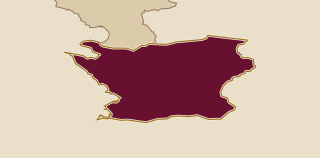
Blekinge is a coastal county in the far south of Sweden, bordering the Baltic. The growing season is short and cool by European wine standards, with summer warmth arriving late and autumn arriving early. Frost risk and limited sun hours rule out the classical European varieties that dominate France or Germany. What Blekinge can offer is enough warmth between June and September to ripen a grape engineered for exactly those conditions.
Karlskrona, ten minutes away, is a UNESCO World Heritage naval city on a granite archipelago. The surrounding landscape is low and wooded. The manor estate sits within this geography without dramatic elevation or well-documented slope aspect, but its position in Blekinge's milder southern microclimate is what makes commercial viticulture possible at all.
In the cellar
Vineyards and cellar
Solaris accounts for 98% of plantings. The grape's disease resistance reduces the need for chemical intervention in Blekinge's damp, coastal climate. It achieves phenolic ripeness during the county's short summer, producing grapes with enough natural sugar for dry wine production without artificial concentration.
For the still wine, fermentation and ageing happen entirely in stainless steel with no oak contact. Stainless steel preserves the grape's aromatics intact: the citrus, herbal, and mineral character that Solaris develops in cool conditions comes through without wood overlay or softening. The method is a choice about transparency.
Wines to know
The range in view
The portfolio has two expressions, both built from estate Solaris fruit.
Stora Boråkra Solaris is a dry white wine fermented and aged in stainless steel. It does not touch oak. Across vintages the wine opens with citrus-forward aromatics: candied lemon and white pepper in the 2021, gravel and birch leaf alongside the lemon in the 2024, a grassy and mineral quality in the 2019. The acidity is the consistent defining line, bright and cleansing, with enough grip to carry the wine's modest body without thinning out. The 2025 shows white currant, fresh herbs, green apple and lemon. Vintages vary in density and openness but the acid architecture stays firm.
A useful way in
A bottle to begin with
Start with Stora Boråkra Solaris, the still white. One grape, one county, stainless steel from fermentation to bottle. What comes through is what Solaris does in Blekinge's cool southern growing season: candied lemon and mineral lift on the nose, a firm acid line on the palate, and a finish that stays clean and bright without the support of oak or blending. Choose the 2021 Stora Boråkra Solaris, with ripe lemon, melon and a long, juicy finish with vibrant acidity.