
Why it matters
The producer
Vinhos Barbeito is one of four Madeira houses still held by the founding family, a distinction that matters on an island where hundreds of companies once shipped the wine and most are gone. Mário Barbeito de Vasconcelos founded the house in 1946. His daughter Manuela de Vasconcelos took over after his death in 1985. Her son Ricardo Freitas joined full-time in 1991 and has run the cellar since.
Freitas changed the house in several specific ways. He stopped bulk sales in 1991, making Barbeito the first Madeira company to do so entirely. In 2001, after five years of internal disagreement, he removed caramel from every wine in the range. He applied canteiro ageing, the slow warehouse method reserved for vintage Madeira, to the everyday Island Madeira reserve bottles as well. Barbeito maintains an inventory of 1.2 million litres, annual sales of 180,000 to 190,000 litres, and a customer base whose average age has dropped from 60 to 40 under his watch.
Place and vineyards
Where the wines begin
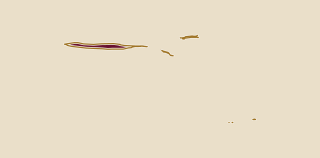
Madeira is a Portuguese archipelago in the Atlantic, roughly 1,000 kilometres southwest of Lisbon and about 700 kilometres from the African coast. The island rises steeply from sea level to volcanic peaks, and that elevation gradient shapes everything about how the wine is grown and what it tastes like. Vines planted at altitude gain more acidity and less sugar than coastal parcels; the microclimates at different heights produce grapes that differ in ripeness, weight, and the rate at which they maderise during ageing.
Madeira DOC is the appellation covering all wine production on the island. The fortified wines here are distinguished by maderisation, a deliberate oxidation driven by heat during ageing. Historically Madeira's stability under heat and movement made it the preferred wine for long Atlantic voyages, and it was widely drunk in colonial America. Today it is a small category, with a handful of houses producing it at serious levels.
In the cellar
Vineyards and cellar
Barbeito sources from vineyards across the island, including parcels in São Jorge on the north coast.
In the cellar, canteiro ageing defines the house style. Casks are placed in warehouses with roof exposure to natural sunlight, and the wine ages slowly through seasonal temperature variation. The warm summers and mild winters drive gradual oxidation and concentrate the wine over years. For the Malvasia Old Reserve, French oak casks are used for a minimum of ten years. No caramel additions have been made since 2001. Fermentation is managed to preserve residual sugar in Malvasia at levels that balance the natural acidity of the grape.
Wines to know
The range in view
Barbeito works with four noble Madeira varieties. Malvasia, the richest and sweetest, is the signature grape. Verdelho sits in the medium-dry register. Sercial produces the driest wines, with firm acidity and a long finish. Bual falls between Verdelho and Malvasia, fuller and slightly sweeter.
The range moves from multi-vintage reserves at three, five, and ten years through colheita single-harvest bottlings and into vintage-dated wines with decades of ageing behind them. The Island Madeira reserves are the everyday tier and receive canteiro ageing rather than estufagem, which separates them from most commercial Madeira at their price level. The colheita and vintage wines extend that same method across longer periods.
A useful way in
A bottle to begin with
Start with the Malvasia Old Reserve 10 Year Old. It is Malvasia from São Jorge vineyards, aged for more than ten years in French oak by the canteiro method, with no caramel addition since 2001. In the glass it is bright gold, warm on the nose with citrus, honey, and almonds, and full on the palate with a spicy, persistent finish that the grape's natural acidity keeps from becoming sweet in a flat way. It shows what canteiro does to Madeira's richest grape over a decade: oxidative complexity without hardness, sweetness without weight, and a finish that lingers.