
Why it matters
The producer
In 1992, Piera Martellozzo was handed a small wine estate in the Padua area and a single instruction from her father Mario: keep it going. She did more than that. Over the following years she shifted the producer's entire gravity eastward, from the Veneto into Friuli Venezia Giulia, and in 1998 launched the first certified organic wine range under the family name. The brand she built carries her name and the founding year together: Piera 1899.
The estate is now headquartered in San Quirino, in the Province of Pordenone, in the northeastern tip of Italy. The founding dates to Giovanni Martellozzo in 1899, and the lineage runs Giovanni to Mario to Piera. Three generations, one deliberate move toward a cooler, more aromatic part of Italy, and a range built around that choice.
Place and vineyards
Where the wines begin
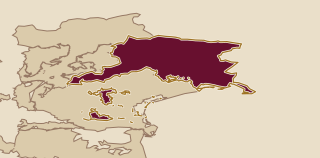
Friuli Venezia Giulia sits in Italy's northeastern corner, bordered by Austria to the north, Slovenia to the east, and the Adriatic to the south. San Quirino and the Province of Pordenone occupy the western part of the region, an area of alpine foothills, river plains, and gravel subsoils that produce some of Italy's most aromatic white wines.
The deliberate migration from Veneto to Friuli was a decision about grape character. Friuli's climate, cooled by alpine air from the north and moderated by the Adriatic, allows Sauvignon Blanc, Ribolla Gialla, and Pinot Grigio to ripen slowly, holding acidity and amplifying aromatic compounds that would be lost in warmer zones. The Friuli DOC label that appears on Terre Magre bottles covers this broad regional character and permits these varietal whites.
In the cellar
Vineyards and cellar
Martellozzo works with vineyard tenders across Friuli Venezia Giulia through a relationship-driven sourcing model. The producer invests time in knowing the people who farm the vines, their families, and their parcels before committing to fruit. That approach shapes selection quality more than scale.
Across the Terre Magre line, all wines are vinified in stainless steel. Fermentation runs at controlled temperatures, a technique that preserves the volatile aromatic compounds in Sauvignon Blanc and Ribolla Gialla that would otherwise dissipate in a warmer ferment. After fermentation, the wine remains on its fine lees, which builds weight and aromatic persistence without adding oak character. The wines carry grape and place forward rather than cellar intervention.
Wines to know
The range in view
The Terre Magre range is built around three mono-varietal whites, each vinified in stainless steel and labelled under the Friuli DOC appellation.
Terre Magre Sauvignon is the flagship. At 12% alcohol, it opens with passion fruit, white peach, sage, tomato leaf, and pepper, with a mineral thread that runs through the mid-palate. The palate is fleshy and aromatic, with close alignment between nose and mouth.
A useful way in
A bottle to begin with
Terre Magre Sauvignon, Friuli DOC. This is a stainless-steel Sauvignon Blanc fermented at controlled temperatures and aged on fine lees in the northeastern Friuli Venezia Giulia region, from Magredi vineyards where gravel soils drive aromatic intensity through thermal contrast. The wine is bright straw-yellow with greenish shades, 12% alcohol, and opens with sage, pepper, tomato leaf, white peach, and passion fruit. The palate is fleshy and aromatic with mineral grip from the Friuli subsoil and a clean, herb-edged finish. It is the most clearly Friuli bottle in the range, the most documented, and the sharpest single expression of what the producer does: varietal, unadorned, place-driven.