
Why it matters
The producer
Vriesenhof began as Jan Coetzee’s estate project after a formative stretch at Kanonkop, where he started his winemaking career in 1967 and made that farm’s first vintage in 1973. At Vriesenhof, the first 1981 vintage set a wider brief: Chardonnay and Pinot Noir alongside Pinotage and Bordeaux-oriented varieties. That mix still gives the cellar more than one register to work in, from white-wine fruit shaped in barrel to reds whose structure depends on grape and élevage.
Adam Mason now makes the wines. The current estate range keeps Chardonnay, Pinot Noir and Pinotage in view, so Vriesenhof is not a single-grape proposition: the bottle choice determines whether the experience begins with barrel-fermented white-wine texture, Pinot Noir’s lighter red frame, or Pinotage’s fruit-and-flower character.
Place and vineyards
Where the wines begin
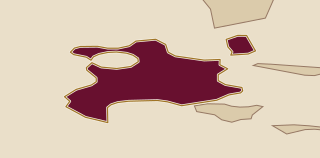
Paradyskloof Valley sits within Stellenbosch, in South Africa’s Western Cape. Atlantic Ocean breezes pass through the valley all year, making this climate cue central to the estate’s vineyard setting. For grapes such as Chardonnay, Pinot Noir and Pinotage, the important consequence is not a generic regional style but a site where growing conditions are considered alongside the different ripening needs of white and red varieties.
Stellenbosch is the wider wine area; Paradyskloof is Vriesenhof’s more particular valley location. That distinction matters in the glass because a Vriesenhof label can carry grape variety as the immediate guide—Chardonnay, Pinot Noir or Pinotage—while the valley supplies the physical setting behind the fruit that reaches the cellar.
In the cellar
Vineyards and cellar
The vineyard roster includes Chardonnay, Pinot Noir, Pinotage and Bordeaux-oriented plantings. Hand harvesting gives the estate a common vineyard practice across grapes, but the wines diverge in the cellar: the Chardonnay record centres on barrel fermentation, Pinot Noir on its own vinification and ageing, and Pinotage on oak treatment.
Those are materially different choices. Barrel fermentation places Chardonnay fruit in contact with oak during fermentation; Pinotage’s oak treatment shapes a red wine already associated here with fruit and floral character; Pinot Noir is handled as a separate red-wine expression with its own ageing potential. Mason’s role is therefore not to force one texture across the range, but to work with grapes that arrive with different structures and bottle roles.
Wines to know
The range in view
Vriesenhof’s documented range overview covers six wines, with detailed wine records for barrel-fermented Chardonnay, Pinot Noir and Pinotage. Chardonnay provides the white-wine axis: fruit meets barrel fermentation, with cellar practice and ageing potential part of the bottle’s shape. It is the range’s clearest meeting point between Coetzee’s Burgundy search and Vriesenhof’s present-day wine list.
Pinot Noir supplies the lighter red-grape lane. Its record covers vinification, ageing potential and structural character, placing aroma and texture ahead of the fuller, oak-treated profile suggested by Pinotage. Pinotage, by contrast, brings fruit and floral notes through a grape closely associated with South Africa, with oak treatment adding another layer to its body and finish.
A useful way in
A bottle to begin with
Choose the barrel-fermented Chardonnay first. It is the bottle that joins Vriesenhof’s most distinctive historical thread—the search for Chardonnay in Burgundy—to a concrete cellar practice. Expect Chardonnay fruit shaped by barrel fermentation, with oak contributing texture and a longer, more developed feel than a purely fruit-led white; its documented ageing potential adds another reason to give the wine time in bottle.