
Why it matters
The producer
Wannborga på Öland makes wine and spirits from 2.5 hectares of cold-adapted vines on Öland, a long Baltic island off Sweden's southeast coast. The estate sits in Borgholms kommun, roughly 50 km from the city of Kalmar, and every bottle is made in a converted farm outbuilding that serves as both winery and distillery. Production volumes are genuinely small: typically a few hundred litres per wine, occasionally reaching a few thousand.
Sweden did not permit commercial grape cultivation until 1999. Wannborga planted its first half-hectare shortly after, at a point when the island had no established wine culture and no local model to follow. That founding moment matters because the estate had to work out cold-climate viticulture on Öland largely from first principles, selecting varieties that could ripen reliably under Baltic conditions and building a winery from existing farm infrastructure rather than purpose-built facilities.
Place and vineyards
Where the wines begin
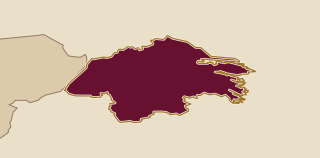
Öland is a narrow limestone island running roughly 130 km from north to south in the Baltic Sea. The island's climate is cooler and drier than the Swedish mainland, with long summer days that extend the growing season, and Baltic winds that moderate temperature swings. The island sits at a latitude where commercial viticulture is marginal: grapes ripen, but the window is tight and the varieties must be selected for cold tolerance rather than warmth preference.
The Baltic context also means no formal wine appellation: Swedish wine law does not yet operate a classified regional system comparable to those in France or Germany. Wannborga's wines carry the producer name and the Swedish origin, and the Systembolaget listing is the formal route to market.
In the cellar
Vineyards and cellar
All ten varieties grown at Wannborga are cold-climate adapted. Variety names are not disclosed in estate communications, but the selection across a farm planting from the early 2000s onward on Öland would have drawn from the pool of Scandinavian-viable cultivars: hybrids and early-ripening central European varieties capable of surviving Baltic winters and ripening in short, cool summers.
The cellar is in the converted milk barn. Both wine and spirits production take place there, which means the building functions as fermentation space, ageing cellar, and still-house simultaneously. Oak ageing is used for the two reds and the solera fortified wine. The Solera is maintained through fractional blending, which draws on multiple vintages at once and produces a wine with more consistency across years than the table wines. The table wines, by contrast, are vintage-specific and deliberately variable: each batch differs from the last, and the estate treats that variability as a feature of small-scale production.
Wines to know
The range in view
The range covers four distinct styles, each with a different register.
Wannborga Camilla is the estate's white wine, made from cold-climate varieties and bottled at 12% ABV. The 2023 vintage sits at the aromatic and fresh end of the spectrum: yellow pear and gooseberry on the nose, almond paste in the mid-palate, and a lemon-driven finish with high, cutting acidity. There is no oak contact. The acidity is the defining structural fact, and it reflects the cold growing season more directly than any cellar decision.
A useful way in
A bottle to begin with
Start with Wannborga Camilla. It is the estate's white wine, made from cold-climate varieties at 12% ABV, and it shows more directly than any of the reds what growing grapes on Öland actually produces. The acidity is high and immediate, the aromatics run to pear and gooseberry rather than tropical fruit, and the almond paste quality in the mid-palate gives it enough weight to carry a meal. The lemon finish is clean and precise. There is no oak, no secondary complexity from ageing: what is in the glass comes from the vineyard and the Baltic growing season. That is where Wannborga starts, and Camilla is the most direct read of it.