
Why it matters
The producer
Waterford is an estate defined less by one prescribed red blend than by a planted field of options. Kevin Arnold, the estate’s first winemaker, planted 11 red grape varieties to find which suited the property: Cabernet Sauvignon, Merlot, Shiraz, Sangiovese, Barbera, Mourvèdre, Grenache, Malbec, Petit Verdot, Cabernet Franc and Tempranillo. That decision still shapes a range in which a multi-variety signature blend, The Jem, sits alongside varietal wines such as Kevin Arnold Shiraz.
The Ord family established Waterford on 1 April 1998 and remains its steward. From the start, the estate paired a family project with an experimental vineyard plan: instead of narrowing the red plantings to one familiar variety, Kevin Arnold put 11 red varieties into the ground. Cabernet Sauvignon and Merlot could work alongside Mediterranean grapes such as Sangiovese, Barbera, Grenache and Tempranillo, making blending and varietal bottlings possible from the same estate.
Place and vineyards
Where the wines begin
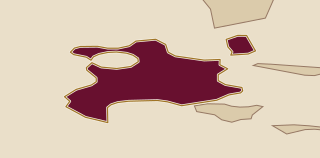
The estate lies in Stellenbosch, in South Africa’s Western Cape, on the Helderberg Mountain slopes. Its address matters on the label as a Stellenbosch estate wine rather than as a single-vineyard bottling: Waterford draws its range from one property while using several grapes and wine styles. The result is a portfolio built for comparison—Chenin Blanc beside red blends, Shiraz beside Cabernet-led wines—rather than a house tied to one variety alone.
Waterford has 120 hectares, but only 60 are planted to vine. The remaining 60 hectares are retained for natural vegetation and wildlife, leaving vines within a larger working landscape rather than covering the whole property. No soil composition is documented here, so the useful site fact is scale: the vineyard blocks share the Helderberg slope with uncultivated ground.
In the cellar
Vineyards and cellar
Cover crops, livestock used for soil aeration and ladybugs for natural pest management are part of Waterford’s regenerative vineyard programme. The estate also holds Integrated Production of Wine certification. These choices keep attention on the vineyard floor and pest pressure before fruit reaches the cellar, where the aim is sound, evenly ripened grapes for wines with fresh fruit and measured structure.
Kevin Arnold Shiraz 2021 shows the cellar work in detail. Its 91% Shiraz and 9% Mourvèdre were hand-harvested, destemmed and kept as uncrushed whole berries for about 14 days of fermentation. After pressing, the wine completed malolactic fermentation and ageing in old French oak; the blend was assembled after six months, then racked twice before bottling. Old barrels support the wine’s savoury fruit and tannin without making overt oak the main flavour.
Wines to know
The range in view
The Jem is Waterford’s signature red blend, drawing on the estate’s broad red-grape planting rather than presenting a single-variety statement. Around it, Cabernet Sauvignon, Merlot, Shiraz, Sangiovese, Barbera and the other planted reds offer different routes through the property: dark-fruited Cabernet and Merlot structure, peppery Shiraz weight, and the brighter cherry-and-acid profile associated with grapes such as Sangiovese and Barbera.
White and sparkling wines widen the range beyond red blends. Pecan Stream Chenin Blanc is the clearest white reference point: 100% Chenin Blanc, 13% alcohol, 5.6 g/L total acidity and 3 g/L residual sugar. Kevin Arnold Shiraz 2021 is fuller in shape at 13% alcohol, with 5 g/L total acidity, 1.5 g/L residual sugar and a dry finish. Together, they show that Waterford’s range moves between lees texture, fruit acidity, tannin and savoury depth.
A useful way in
A bottle to begin with
Start with Pecan Stream Chenin Blanc. It is 100% Chenin Blanc, and its oak, stainless-steel and concrete ageing makes Waterford’s practical, multi-part approach easy to taste in one glass. Expect dry fruit, lively acidity and a fuller lees texture through the palate, with oak kept to a touch of sweetness rather than a dominant flavour. It introduces the estate’s white-wine side without requiring a tour through the many red varieties.