
Why it matters
The producer
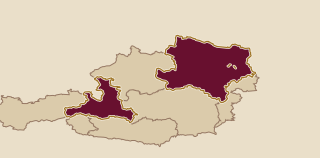
Weingut Allram is a family winery in Straß im Straßertal, part of Kamptal in Lower Austria. Walter Allram converted a post-war farm of about 12 hectares into a winery during the 1950s; the estate now reports 30 hectares around Straß. That expansion has kept its centre in the village: Grüner Veltliner Strass is made from the grape most closely associated with the estate’s local vineyards, while Riesling Vinotheksreserve shows a slower, cellar-aged side of the range.
Lorenz Haas-Allram has been responsible for vinification since 2015. He and Magdalena represent the current generation, progressively moving the estate towards biodynamic farming. The result is a family operation whose bottles move from a direct village Grüner Veltliner to wines tied to designated vineyard sites and longer ageing.
Place and vineyards
Where the wines begin
Straß lies in the Straßertal, within Kamptal. For Allram, the place appears on the label at more than one scale: a wine labelled Strass draws on vineyards around the village, while the estate also works three Erste Lage sites. The distinction matters in the glass. A village Grüner Veltliner gathers a broader local picture; a designated-site wine narrows attention to one vineyard origin.
Kamptal gives the estate room for both Grüner Veltliner and Riesling. Grüner Veltliner anchors the Strass bottling, where dry fruit and acidity are the immediate focus. Riesling appears in the Vinotheksreserve, where extended ageing shifts attention towards texture, development and the finish.
In the cellar
Vineyards and cellar
All grapes at Allram are harvested by hand. On the estate’s slopes, that allows bunches to be picked as vineyard work requires rather than as a machine schedule dictates; the practical consequence is more choice at harvest before fruit reaches the cellar.
Lorenz and Magdalena are progressively converting the estate to biodynamic farming, while Lorenz’s vineyard work includes steep, previously forgotten sites. Those are farming decisions rather than a promise of one uniform flavour across 30 hectares. Their clearest effect is range structure: fruit from vineyards around Straß can become the village Grüner Veltliner, while selected sites can remain distinct for site-designated wines. In the cellar, the Vinotheksreserve adds extended élevage, giving Riesling time to develop a broader texture and a longer finish.
Wines to know
The range in view
The accessible end of the range is Grüner Veltliner Strass. It is a village-level Grüner Veltliner, sourced from vineyards around Straß, so its job is to show the estate’s local grape and village origin in one dry white. The 2024 bottling is described with fruit, fresh acidity, texture and a persistent finish: a useful combination when Grüner Veltliner is being asked to work at the table rather than merely refresh the palate.
Above that broader village expression sit wines from Allram’s three Erste Lage sites. Their role is more specific: each keeps a named vineyard origin visible rather than blending it into the Straß bottling. At the other end of the range, Riesling Vinotheksreserve 2013 is an older reserve wine with extended élevage. It is not simply a more intense version of the Grüner; its age and cellar time put developed aroma, weight and finish at the centre.
A useful way in
A bottle to begin with
Start with Grüner Veltliner Strass 2024. It is a dry village Grüner Veltliner made from vineyards around Straß, and its fruit, fresh acidity, texture and lingering finish make the place-and-grape relationship easy to taste. It comes before the site wines because it gathers the estate’s village fruit into one bottle; it comes before the Vinotheksreserve because its youthful, direct shape asks less knowledge of aged Riesling.