
Why it matters
The producer
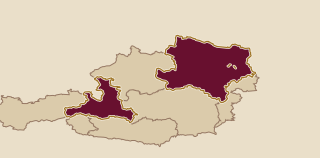
Martin and Anna Arndorfer returned to Kamptal, the region they call home, to make wine at Weinbergweg 16 in Strass im Strassertal. Kamptal and Strassertal are the appellation names connected with the estate, while Grüner Veltliner provides its most useful reference point: a familiar Austrian grape used here in both conventional and deliberately less conventional forms.
The estate grew from a family mixed farm dating to 1770, and Martin is described as the third generation to focus on wine. After travelling, Martin and Anna came back to Kamptal and made wines that could depart from local expectations. Their choice was not to abandon the home region, but to keep working there while allowing a bottle’s style to determine whether it fitted an appellation category. That decision opens space for wines such as Per Se Grüner Veltliner, where skin contact and unfiltered bottling put tactile grip ahead of a standard regional profile.
Place and vineyards
Where the wines begin
Strass im Strassertal sits within Kamptal, so a bottle can carry either the wider Kamptal name or the more local Strassertal name. That distinction frames the range rather than locking it into one style. Grüner Veltliner and Riesling belong to the regional conversation, but Arndorfer also works with a wider registered planting list that includes Zweigelt, Chardonnay, Roter Veltliner, Neuburger and several other varieties. The result is a cellar with room for white, rosé, red and skin-contact wines rather than a single regional formula.
The documented site information centres on Strass im Strassertal and the Kamptal growing area, not on named soil types or individual parcels. That leaves the wine labels and cellar choices as the clearer guides to what is in the glass: a classic Grüner Veltliner is shaped for freshness and spice, while a skin-fermented Grüner draws texture and tannin from extended contact with its grape skins.
In the cellar
Vineyards and cellar
Organic farming is the estate’s stated agricultural base, keeping the vineyard work aligned with a cellar that uses comparatively little correction. The wines are not handled through one fixed recipe. Strasser Weinberge Grüner Veltliner spends ten months in 80% neutral barrels and 20% stainless-steel tanks; neutral wood can broaden body without laying a strong new-oak flavour over the fruit, while steel keeps the finish clean.
Per Se Grüner Veltliner follows a different route: it ferments on its skins for 16 days, then is bottled unfiltered and unfined. Skins supply tannin and a firmer, more tactile texture; leaving the wine unfiltered and unfined preserves that material in the bottle. Elsewhere in the natural-wine range, lees ageing and barriques add further options for weight, aromatic detail and savoury depth.
Wines to know
The range in view
The range has two useful lanes. The classic wines include Grüner Veltliner, rosé and Zweigelt, with the Grüner described through fruit, freshness, spice and finish. These are the wines where Grüner’s lively acidity and spice remain close to the surface, while the red and rosé widen the estate beyond white wine.
The second lane is more exploratory. Handcrafted Grüner Veltliner brings fruit, texture and spice together in a fuller expression. Strasser Weinberge takes Grüner toward a rounder, more layered body through long ageing in neutral barrels and steel. Per Se takes the grape into skin-contact territory, where aromatic fruit is joined by dry tannin and grip. These are not different labels for the same wine; each uses a distinct method to alter body, texture and finish.
A useful way in
A bottle to begin with
Choose Strasser Weinberge Grüner Veltliner. It is a Grüner Veltliner aged for ten months in 80% neutral barrels and 20% stainless steel, a combination that makes its cellar work easy to feel without turning the wine into an oak exercise. Expect fruit and spice carried by a rounder texture, fresh acidity and a clean finish. It is the right first bottle because it connects Kamptal’s central grape to Arndorfer’s preference for shape and texture over a fixed template.