
Why it matters
The producer
Josef Kesseler laid the estate’s foundation in 1924 when he took over Assmannshausen’s former winegrowers’ cooperative. August Kesseler has been responsible since 1977, after practical experience in France, Italy and the United States. That history now lands in a two-grape cellar: Pinot Noir carries the steep red-wine slopes around Assmannshausen, while Riesling follows sites stretching through Eltville, Erbach, Rüdesheim, Lorch and Lorchhausen.
In the 1980s, August Kesseler and Max Himstedt set out to revive Assmannshausen’s reputation for balanced wines. The work had a practical direction: steep Pinot Noir sites such as Höllenberg were treated as places worth bottling under their own names, rather than merely supplying an undifferentiated red blend. Kesseler’s experience abroad also sits behind a cellar approach that separates small parcels before blending, allowing a Daily wine to combine fruit from several sites while a GG keeps a single slope in focus.
Place and vineyards
Where the wines begin
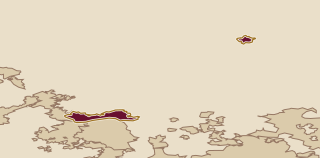
Assmannshausen sits in the lower Rheingau, where the Rhine valley narrows and vineyard slopes steepen. Pinot Noir is central here because the estate’s Höllenberg parcels combine slope with sparse slate that holds heat, helping fruit reach ripeness while retaining the firm shape needed for dry red wine. Riesling comes from a broader set of Rheingau sites, so its labels move from regional fruit in The Daily August to named slopes such as Rüdesheim Berg Schlossberg and Lorchhausen Seligmacher.
Assmannshäuser Höllenberg is a 45% slope of sparse, heat-retaining slate. Pinot Noir from this ground is bottled as Höllenberg GG, with the dry 2024 showing cassis, blackberry and cherry over balanced tannin, fine mineral character and a silky texture.
In the cellar
Vineyards and cellar
The estate vinifies its vineyard parcels separately, then uses blending where the wine calls for it. For The Daily August Riesling, the 2023 fruit from Eltville and Erbach was handled in separate lots in stainless steel before blending; the result is a light-bodied dry Riesling with apple, lemon, lime and pear rather than oak weight. A 2025 release also spent three months in stainless steel, keeping blood orange, red plum and lavender close to the surface while juicy acidity carries the finish.
Stainless-steel tanks and French oak barriques both have roles at the estate. The vessel choice matters most in the glass: steel can keep Riesling’s citrus fruit and acidity clear, while Pinot Noir from sites such as Höllenberg can use oak as part of a broader texture alongside tannin, dark fruit and dry extract. Site-by-site work leaves the cellar with components whose soil and slope differences can remain visible after fermentation.
Wines to know
The range in view
The range begins with The Daily August Riesling and Pinot Noir, then steps into village and vineyard wines. The Daily August Riesling uses classified-site fruit despite its broader sourcing; its light body, bright acidity and wet-stone finish make it the brisk white end of the range.
Assmannshausen Alte Reben Cuvée Max is a VDP.ORTSWEIN Pinot Noir, placing old-vine fruit from the village between the daily red and the Grosse Gewächse. Above it, Assmannshausen Höllenberg GG narrows the focus to Pinot Noir from the slate slope, while Rüdesheim Berg Schlossberg GG exists in both Pinot Noir and Riesling. The Riesling side also includes Lorch, Rüdesheim Berg Roseneck GG, Rüdesheim Berg Schlossberg GG and Lorchhausen Seligmacher Riesling GG, each label tying the wine to a named Rheingau place.
A useful way in
A bottle to begin with
Assmannshausen Höllenberg GG Pinot Noir is the bottle to start with when the aim is to meet Kesseler’s red-wine side at full site definition. It is a dry VDP.GROSSES GEWÄCHS from Pinot Noir on Höllenberg’s 45% heat-retaining slate slope, and its cassis, blackberry and cherry fruit is held by balanced tannin and a silky, mineral texture. The bottle brings Assmannshausen, steep slate, Pinot Noir and the estate’s parcel-led approach into one glass without needing a catalogue of labels.