
Why it matters
The producer
Axel Pauly works about 10 hectares centred on Lieser, with a small parcel in neighbouring Bernkastel. The named sites, Lieserer Niederberg-Helden and Bernkastel-Kueser Weisenstein, locate the Riesling range in two nearby Mosel places rather than a single undifferentiated vineyard holding.
The estate’s bottles move between dry Riesling, Kabinett Trocken and Feinherb, with barrique-aged reds alongside them. That spread follows the plantings: Riesling supplies the citrus-and-acidity line, while Pinot Noir and Dornfelder permit wines shaped by darker fruit, oak and a broader texture.
Place and vineyards
Where the wines begin
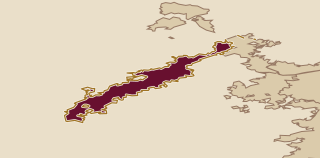
Lieser is the estate’s working base in the Central Moselle, where most of its vineyards lie; Bernkastel contributes a smaller neighbouring parcel. The place names on the estate’s principal sites matter because they tie the wine to steep Mosel slopes and to the slate beneath the vines, rather than presenting Riesling simply as a grape variety.
For the 2023 range, Mosel appears on labels such as Tres Naris Mosel Riesling Trocken, Purist Mosel Riesling Kabinett Trocken and Generations Mosel Riesling Feinherb. The shared regional name holds together wines whose dry or off-dry finish changes the way Riesling’s acidity meets the palate.
In the cellar
Vineyards and cellar
Crop thinning reduces the crop carried by a vine, leaf plucking opens the canopy around the grapes, and harvest selection separates the fruit chosen for wine. At Pauly, those vineyard steps precede a range in which Riesling can be bottled dry or Feinherb, while the red wines receive barrique ageing and therefore carry oak as part of their texture.
The 2023 Tres Naris Riesling received 12 hours of skin contact before a slow, cool, temperature-controlled fermentation. That sequence brings the grape skins briefly into the process, then preserves a fresh Riesling line through a measured fermentation; the finished wine is dry, with lemon, peach, mineral character and a long finish rather than an overt oak profile.
Wines to know
The range in view
Riesling sets the architecture. Tres Naris Mosel Riesling Trocken is the dry varietal wine, carrying blossoms, lemon and peach over fresh acidity and a mineral finish. Its dry label and slow, cool fermentation place citrus and stone fruit ahead of sweetness.
Purist Mosel Riesling Kabinett Trocken is also dry, but its Kabinett designation places it within Germany’s Prädikat system. Generations Mosel Riesling Feinherb takes a different path: Feinherb signals perceptible, balanced sweetness rather than a fully dry finish, so it offers another way for Riesling fruit and acidity to meet.
A useful way in
A bottle to begin with
Choose the 2023 Tres Naris Mosel Riesling Trocken. It is a dry Riesling whose 12 hours of skin contact and slow, cool fermentation connect cellar method to a direct glass of blossoms, lemon and peach, fresh acidity, mineral character and a long finish. It comes before the off-dry Generations because its dry shape makes the estate’s Riesling-and-slate focus easiest to taste without sweetness changing the frame.