
Why it matters
The producer
Weingut Bergkloster is a family winery in Westhofen, now led into its fifth generation by Jason Groebe. The estate has more than 120 years of family history, but its present wines carry Groebe’s own direction: he studied winemaking at Geisenheim, spent years working in the vineyards, and took responsibility for a small holding spread across several Westhofen sites. That combination puts Riesling and Pinot varieties beside a red blend such as Super Lecka, where red and white grapes meet in one dry bottle.
Jason Groebe inherited a family estate but did not simply repeat its earlier cellar routine. After Geisenheim and years in the vines, he moved toward wines made with less handling; the family gave him room to pursue that direction. His early work developed into a fully low-intervention approach in 2018, reported without filtration, fining or added sulfites. That decision has a visible consequence in wines such as Super Lecka, which is listed as lightly cloudy rather than cleared to a bright, conventional appearance.
Place and vineyards
Where the wines begin
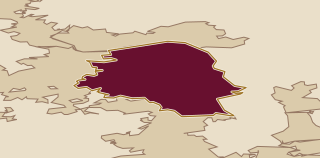
Westhofen sits in Rheinhessen, and Bergkloster’s nine hectares extend around the village through Kirchspiel, Morstein, Aulerde and Steingrube. Those names matter on a Bergkloster bottle because they locate the fruit within a compact Westhofen holding rather than in a broad regional blend. The estate grows both white and red grapes there, so place is not used to narrow the range to one style: it supplies fruit for Riesling, Pinot wines and the mixed-grape Super Lecka.
Limestone, clay, marl and deep loess occur across Bergkloster’s vineyards. The estate therefore farms vines on more than one physical ground type within its nine hectares, rather than treating Westhofen as a single uniform site. The consequence in the cellar is a varied pool of fruit: grapes from named parcels can remain distinct where needed, while a wine such as Super Lecka can bring several varieties into one lively, low-alcohol red.
In the cellar
Vineyards and cellar
Bergkloster is reported as organically certified since 2006, with vineyards worked without chemical or synthetic pesticides. On nine hectares, that approach is practical as well as philosophical: Jason Groebe can work closely with fruit from Westhofen’s limestone, clay, marl and loess soils before deciding whether it belongs in a varietal wine or a blend. The estate’s grape list—from Riesling and Chardonnay to Pinot Noir and Sankt Laurent—gives that farming a broad set of possible results.
In the cellar, the reported approach uses no added yeast and minimal sulfur intervention; from 2018, the wines were made without filtration, fining or added sulfites. These choices leave more of the wine’s original material in bottle, which helps explain the lightly cloudy appearance documented for Super Lecka 2022. One retailer’s account of a Super Lecka release also describes Pinot Noir fermented in an open vat, then a split between large oak and stainless steel before bottling after nine months. That is release-specific detail, not a rule for every Bergkloster wine.
Wines to know
The range in view
The recorded range includes white, red, rosé and orange wines, with Chardonnay and Riesling among the whites. At the red end, Super Lecka is the estate’s entry-level cuvée: a bottle built for fruit and lively acidity rather than a single-grape statement. Its role is useful because it brings Bergkloster’s mixed planting and low-intervention cellar work into a wine meant to be opened young.
Super Lecka 2022 is a dry, still red made from hand-picked estate grapes. Its blend is 30% Regent, 30% Pinot Noir and 20% Sankt Laurent, with 5% each Müller-Thurgau, Riesling, Pinot Gris and Pinot Blanc. The red grapes supply the main body and fruit, while the four white varieties make up a fifth of the blend. It is a deliberately mixed composition, and its lightly cloudy appearance belongs to the wine’s unfiltered presentation rather than to sweetness: the listing describes it as dry.
A useful way in
A bottle to begin with
Start with Super Lecka 2022. It is a dry, still, lightly cloudy red at 10.5% alcohol, made from three red grapes and four white varieties: Regent, Pinot Noir, Sankt Laurent, Müller-Thurgau, Riesling, Pinot Gris and Pinot Blanc. In the glass, expect cherry, rhubarb, blackcurrant, floral notes and brisk acidity. Its unusual blend makes the Westhofen estate’s broad planting visible, while its unfiltered look and low-intervention handling bring Jason Groebe’s cellar direction into immediate view.