
Why it matters
The producer
Weingut Bernhart stands in Schweigen, where the Pfalz meets France and the estate’s vineyard map crosses the border with it. Sabine and Gerd Bernhart run the fourth-generation family estate, while Gerd also directs the cellar. The result is a dry, Burgundian-led range in which a Pfalz label can come from vineyards on the Alsatian side of the border.
The estate’s recent direction rests on two later decisions: sustained work with red Spätburgunder began toward the end of the 1980s, and Bernhart joined the VDP in 2004. Together, those steps sit behind a range that moves from VDP.Gutswein, made from several estate vineyards, to VDP Erste Lage wines such as the Sonnenberg Spätburgunder and St. Laurent S. The older family holdings, some owned for as long as a century, keep that expansion rooted in vineyards rather than a newly assembled brand.
Place and vineyards
Where the wines begin
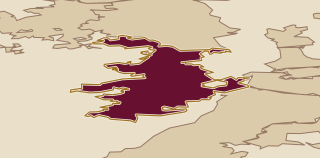
About 12 of the estate’s approximately 17 hectares lie in Alsace, yet a special regulation permits these French vineyards to supply wines labelled as Pfalz. That unusual arrangement is more than a curiosity on a map: Spätburgunder, Pinot Blanc and Riesling can carry a Pfalz regional name while growing immediately across the frontier from Schweigen. The 2022 estate Spätburgunder, drawn from vineyards around Schweigen and Weißenburg, is the clearest broad expression of that cross-border setting.
Limestone marl is central to Bernhart’s Pinot Blanc, Pinot Gris and Pinot Noir vineyards. The estate links it with mineral character in the white Burgundians and with deeper Pinot Noir, a useful context for the dark-fruited 2018 “FG” Schweigen Sonnenberg Spätburgunder. Sonnenberg itself crosses the international border, so the vineyard name joins the same geographical story carried by the bottle’s Pfalz designation.
In the cellar
Vineyards and cellar
Organic cultivation shapes fruit from a vineyard planted 65% to Burgundian varieties and 15% to Riesling. That grape balance explains why Pinot Blanc, Pinot Noir and St. Laurent occupy so much space in the cellar, while dry vinification keeps acidity, tannin and site character in view rather than sweetness.
Cellar detail is firmly documented for the 2018 “FG” Schweigen Sonnenberg Spätburgunder: it spent 17 months in used barriques. Used oak brings tobacco, dark chocolate and spice around the Pinot Noir’s cherry and dark-berry fruit without turning the wine into an overtly woody red. For the 2022 St.
Wines to know
The range in view
The 2022 Spätburgunder Rotwein trocken is a VDP.Gutswein, the estate tier of the VDP system, made from estate-grown grapes across several vineyards around Schweigen and Weißenburg. Its 5.00 g/l acidity and very low 0.30 g/l residual sugar support a dry red with ripe cherry, redcurrant and light spice, a soft texture, medium tannin and a lingering finish.
The 2018 “FG” Schweigen Sonnenberg Spätburgunder Erste Lage trocken narrows the focus to a named site. Here, 17 months in used barriques frame blackberry, dark berries and cherry with tobacco, dark chocolate and fine spice. Fresh acidity and limestone character give the substantial palate lift, while the tannin and weight suggest a bottle made to hold in the cellar.
A useful way in
A bottle to begin with
Start with the 2022 Spätburgunder Rotwein trocken. As a VDP.Gutswein from several estate vineyards around Schweigen and Weißenburg, it shows Bernhart’s dry red-wine direction without asking one site to speak for the whole estate. Ripe cherry, redcurrant and light spice sit over 5.00 g/l acidity, with a soft palate, medium tannin and only 0.30 g/l residual sugar. It is a straightforward way into the producer’s cross-border fruit, Burgundian focus and dry house style.