
Why it matters
The producer
Weingut Birgit Eichinger began in 1992, when Birgit Eichinger made her first wines from 3.5 hectares of family vines. The cellar now sits at the foot of Ried Gaisberg, where grapes from a reported 16 hectares are processed. Birgit and Gloria Eichinger make the wines together, with Grüner Veltliner providing the estate’s main line: its peppery, savoury character lets the individual vineyard names show clearly on the label.
Eichinger’s growth has followed the vineyard names rather than a single blended house wine. From the 3.5-hectare beginning in 1992, the work expanded to grapes from 16 hectares, including sites with markedly different soils and exposures. That move changes the range in practical terms: Grüner Veltliner can run from Hasel’s rounded fruit to Wechselberg’s denser palate, while Gaisberg also supplies Riesling with citrus-led acidity and a longer, more structured finish.
Place and vineyards
Where the wines begin
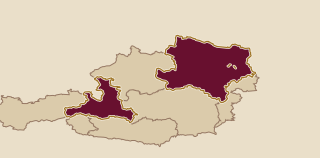
The estate is in Straß im Straßertale, in Lower Austria’s Kamptal. Its key sites include Gaisberg, Heiligenstein, Lamm and Grub, with Hasel, Wechselberg and Stangl close to the winery. Heiligenstein, Lamm and Gaisberg carry the Erste Lage 1ÖTW classification, a formal designation attached to named sites; when one of those names appears on a bottle, the wine is tied to that particular vineyard rather than presented as a broad regional blend.
The estate describes its single-vineyard ground as a meeting point of complex soils, cool microclimates and reliable ripening conditions. Those differences emerge most plainly in Grüner Veltliner. Hasel’s deep loess supports a rounded palate with orchard fruit and bright acidity, while Wechselberg produces a fuller wine with stronger spice and mineral character. Gaisberg is divided into nine terraces of brown earth and crystalline rock, giving its wines a firmer, more layered frame. Lamm combines volcanic and loess material, while Heiligenstein has weathered volcanic soil.
In the cellar
Vineyards and cellar
In the vineyards, canopy management, cover crops and soil- and vine-conscious work are part of the estate’s sustainability programme. Keeping cover between the rows and managing the canopy are practical ways to attend to the vine and soil, while the cooler site conditions help retain acidity as fruit ripens. In the cellar, the estate links gentle vinification with shorter transport distances, energy efficiency and water management.
The 2017 Gaisberg Riesling shows how a named parcel can be handled directly: the grapes were whole-bunch pressed, clarified by flotation, fermented in stainless steel and kept on lees for four months. Stainless steel preserves the citrus fruit and dry line of Riesling; lees ageing adds more body and texture without introducing overt oak. By contrast, the 2023 Gaisberg Grüner Veltliner spent time in a large wooden barrel, alongside its yellow apple, mango, apricot and blossom-honey notes.
Wines to know
The range in view
Grüner Veltliner is the backbone of the range, and the named Ried bottlings make its site changes easy to follow. Ried Hasel Grüner Veltliner Kamptal DAC is dry and rounded, with orchard fruit, delicate spice and lively acidity. Its deep-loess origin shows in the wine’s broader mid-palate rather than weight alone.
Ried Wechselberg Grüner Veltliner moves toward yellow apple and stone fruit, with more pronounced spice, mineral character and a denser texture. The structure is more powerful and the finish longer, making it a bottle suited to a meal or a few years of bottle age. Ried Gaisberg 1ÖTW Grüner Veltliner brings citrus, white pepper and herbs, then fresh acidity and fine spice; the 2023 adds ripe yellow fruit and an oak-derived breadth from large wood.
A useful way in
A bottle to begin with
Choose Ried Hasel Grüner Veltliner Kamptal DAC first. It is a single-vineyard Grüner from deep loess, and it sets out the estate’s core grape without the extra density of Wechselberg or the large-wood influence reported for the 2023 Gaisberg. Expect dry orchard fruit, delicate spice, vibrant acidity and a rounded texture. It makes the link between Kamptal vineyard ground and Eichinger’s Grüner Veltliner clear in one glass.