
Why it matters
The producer
Christopher Loewen runs an 18-hectare Riesling estate on the Mosel with his father Karl-Josef and one full-time employee. Three people, one grape, and a parcel of ungrafted vines planted in 1896 that wine writer Stuart Pigott placed among the best dry white wines in the world.
The estate is based in Leiwen, with vineyards spread across four villages: Leiwen, Longuich, Detzem, and Thörnich. More than half of those 18 hectares are ungrafted vines between 60 and 120 years old, grown on steep slate slopes without chemical additives, mechanical pumping, or temperature control in the cellar. The anchor of the range is the Maximin Herrenberg parcel in Thörnich, planted on its own rootstock in 1896 before phylloxera reached the Mosel at scale. That parcel gives the estate its name wine: Riesling 1896 Black Label.
Place and vineyards
Where the wines begin
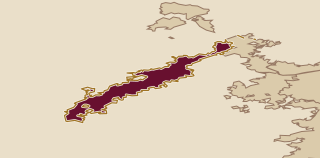
The Mosel cuts a long switchbacking valley through the slate hills of Rhineland-Palatinate in western Germany. The river bends create south- and southwest-facing exposures that allow Riesling to ripen slowly on some of the steepest vineyard slopes in Europe, some exceeding 60 degrees. Loewen's four-village footprint follows this pattern across a long stretch of the middle Mosel: each village sits on slate bedrock, and each parcel faces the sun at an angle that extends the growing season into October and often beyond.
Slate holds and radiates heat overnight, keeping vine roots warm during cool Mosel nights. Old ungrafted vines send roots deeper into that rock than younger grafted vines can, drawing from a different mineral register. The consequence in the glass is a pronounced saline minerality on the finish, and an acid line that cuts through the fruit rather than framing it from a distance.
In the cellar
Vineyards and cellar
Loewen's steep-slope parcels are harvested by hand. On the evening of the harvest, grapes go into a basket press over 100 years old. The press runs without mechanical pumps: juice falls by gravity through the cellar floor into the tanks below. No pumping, no transfer lines, no oxidation risk from mechanical handling.
Fermentation is spontaneous, driven by wild yeasts naturally present on the grape skins. No temperature control is applied. No chemical additives are used at any point. The wines age in old Fuder barrels, the traditional Mosel wooden cask format at around 1,100 litres, with the estate's barrels averaging 25 years old. At that age, Fuder contribute no oak flavour to the wine; they allow very slow micro-oxygenation and preserve the primary fruit and mineral character of the grape.
Wines to know
The range in view
Riesling is the only grape. The range moves from village-level Rieslings through named-vineyard bottlings from parcels across Leiwen, Longuich, Detzem, and Thörnich, then to the Riesling 1896 Black Label at the top.
The village and vineyard-level Rieslings are dry or close to dry, fermented with wild yeasts and aged in old Fuder. They carry the same low-intervention cellar approach as the flagship: no additions, gravity-fed, spontaneous ferment. On the palate they show the lean, high-acid profile of Mosel slate Riesling: citrus-forward, light-bodied, with a stony finish and long acid line. Yields from ungrafted old vines are lower than the regional average, so even the entry bottles carry more concentration than their price level suggests.
A useful way in
A bottle to begin with
Start with the Riesling 1896 Black Label. It comes from one parcel, planted in one year, on its own rootstock, vinified by three people without additions or temperature control. The wine is dry, high-acid, and mineral, with concentrated lemon and lime fruit, a dense mid-palate, and a long saline finish. It is built to age, but it already delivers at release: everything that defines what Loewen does is present in the glass from the first pour. Stuart Pigott described it as one of the best dry white wines in the world after only its fifth vintage.