
Why it matters
The producer
Deutschherrenhof is a traditional Trier estate whose present direction rests with Sebastian Oberbillig, a trained oenologist. His stated aim is distinctive Riesling, so the estate’s Mosel holdings appear most clearly in a range that repeatedly returns to one grape while offering dry and sweeter styles.
Before taking over in 2019, Oberbillig trained at Weegmüller, Reichsgraf von Kesselstatt and Schlossgut Diel, studied viticulture and oenology at Geisenheim, and worked in Austria, New Zealand and London. That route brings formal cellar training into a family estate whose bottles still begin with its Trier vineyards.
Place and vineyards
Where the wines begin
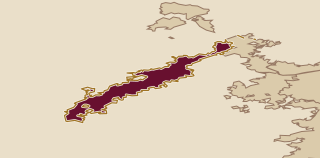
Trier sits in Germany’s Mosel region, and Deutschherrenhof’s vineyards lie on the city’s outskirts. Mosel appears directly on the 2023 Schiefer Riesling Trocken listing; paired with its 100% Riesling composition, the regional name tells you what the bottle is built around before sweetness level or vineyard name enters the picture.
The estate’s focus on Riesling gives the range a useful line of comparison. A dry Schiefer Riesling and a Kabinett or Spätlese can share the same central grape while putting dryness, fruit sweetness and acidity in different proportions on the palate.
In the cellar
Vineyards and cellar
Deutschherrenhof uses manure-based organic fertilisation, winter cover and compost in its vineyards, alongside low yields and selective hand harvesting. Those choices concentrate attention on the fruit brought into the cellar: fewer grapes and selection at harvest make ripeness and condition more consequential to the finished wine.
The estate does not present a single cellar recipe for every bottle. Instead, the range separates dry Riesling from Kabinett, Spätlese and Auslese, so acidity, fruit sweetness and body can take different roles from one label to the next.
Wines to know
The range in view
Riesling provides the range’s backbone. Basic Riesling and Schiefer Riesling Trocken establish the dry end, while site-designated and old-vine wines add vineyard or vine-age detail; Kabinett, Spätlese and Auslese then mark progressively different sweetness and fruit-weight possibilities.
Grosses Gewächs sits in the collection as a dry classified Riesling category, while the Prädikat wines make room for sweetness without abandoning acidity. Alongside them, Burgundy-family wines widen the estate’s offer, though the supported material does not assign those wines specific grapes or tasting profiles.
A useful way in
A bottle to begin with
Start with Schiefer Riesling Trocken, listed in 2023 as Mosel and 100% Riesling. It is a dry bottle that joins the estate’s regional setting to Sebastian Oberbillig’s Riesling focus, while its name points toward the estate’s vineyard-based range rather than a generic white wine.