
Why it matters
The producer
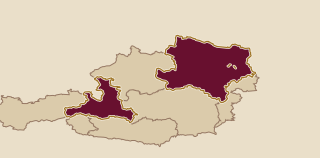
Weingut Dorli Muhr works from Prellenkirchen on the Spitzerberg, the eastern Carnuntum hill where Blaufränkisch is asked to ripen with little rainfall and persistent wind. Dorli Muhr and Dirk Niepoort founded the winery together; Muhr bought his 50% share in 2017 and the estate has since carried her name. With 90% Blaufränkisch across its vineyards, the range uses individual sites to change the grape’s shape: lighter-fruited Kirchweingarten, darker Kranzen and tannin-rich Kobeln Liebkind.
The estate began as a partnership between Dorli Muhr and Dirk Niepoort, then changed hands without changing hills. In 2017, Muhr acquired Niepoort’s half of the business and continued under her own name, keeping the focus on Spitzerberg Blaufränkisch rather than building the range around a wider collection of regions. That decision leaves the wines able to show different parcels through one central grape: a Carnuntum blend at one end, then site bottles whose fruit, body and tannin become more distinct as the labels narrow to Kirchweingarten, Kranzen and Kobeln Liebkind.
Place and vineyards
Where the wines begin
The labels move through a clear chain of names. Prellenkirchen is the village; Spitzerberg is the hill above it; Carnuntum is the Austrian wine region that received DAC recognition in 2019. A bottle named Ried Spitzerberg-Kranzen or Ried Spitzerberg-Kobeln Liebkind therefore points beyond the grape to a named site on that hill. Dorli Muhr’s Carnuntum bottling, by contrast, is a regional blend of two-thirds Blaufränkisch and one-third Syrah, giving a broader red-wine expression of the area.
In the cellar
Vineyards and cellar
The vineyards have followed certified organic-viticulture rules since the 2018 vintage. In a dry, windy place, that farming sits alongside parcel work: each block can be handled for its own soil and ripening pattern before the wines enter the cellar. Lukas Brandstätter oversees the technical cellar work, where spontaneous fermentation keeps the fruit’s route into wine direct and red wines spend two years in large wooden barrels. Large, used casks add slow oxygen exchange without placing overt oak flavour over Blaufränkisch’s cherry fruit, savoury notes and tannin.
Kobeln Liebkind shows the most detailed version of that approach. Its 2019 Blaufränkisch came from berries averaging about eight millimetres, bringing a high ratio of skins to juice and therefore abundant tannin and aromatic material. Part of the fruit underwent whole-stem maceration in open vats; fermentation was spontaneous and extraction avoided pumping. After pressing, the wine rested for 20 months in a large old wooden cask, with one racking, before unfiltered bottling. The result is built for time rather than early softness.
Wines to know
The range in view
The range begins with Dorli Muhr Carnuntum, where Syrah joins Blaufränkisch to make a regional red rather than a single-site statement. From there, the bottles focus inward on Spitzerberg parcels. Ried Kirchweingarten 2022 is 100% Blaufränkisch from limestone, clay and loess, matured for 20 months and bottled unfiltered; its role is fruit, lift and a lighter frame.
Ried Spitzerberg-Kranzen 2021 is also Blaufränkisch, but the estate describes it as darker, fuller and more robust. Twenty months in large used casks supports the wine’s dense, full-bodied 2021 shape while holding on to freshness. Ried Spitzerberg-Kobeln Liebkind 2019 is the most concentrated end of the range: small berries bring more tannin and aromatic material, so the bottle has more grip, weight and a longer ageing curve. The producer advises allowing five to six years in cellar before its full character appears.
A useful way in
A bottle to begin with
Begin with Ried Kirchweingarten 2022. It is a 100% Blaufränkisch that brings the estate’s core elements into one bottle: a named Spitzerberg site, limestone mixed with clay and loess, 20 months of maturation and unfiltered bottling. Compared with Kranzen’s darker, fuller body and Kobeln Liebkind’s dense tannin, Kirchweingarten places its weight in the middle and keeps the texture light on its feet. It shows why Dorli Muhr treats Blaufränkisch as a parcel grape rather than a single house style.