
Why it matters
The producer
Jochen Dreissigacker leads an old Bechtheim estate whose wines are rooted in Rheinhessen rather than a single advertised flagship. The vineyards around Bechtheim and Westhofen supply dry Riesling and Weissburgunder, while the cellar turns that fruit into wines with fresh acidity, lees-derived weight and restrained oak influence. Biodynamic rules have been followed since 2020, extending the estate’s longer-established organic approach.
The estate’s timeline reaches back to 1728, while its present-day direction is led by Jochen Dreissigacker. Organic practice has long formed part of the work, and biodynamic rules joined it in 2020. In the winery, the same patience appears in spontaneous fermentation, separate maturation of different Riesling lots, and time on lees. The consequence is not a uniform recipe: an everyday dry Riesling and a seven-vintage cuvée can share a house approach while arriving at different textures and flavours.
Place and vineyards
Where the wines begin
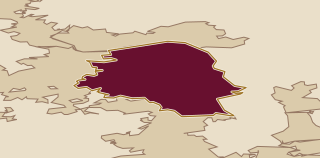
Bechtheim lies in Wonnegau, within Rheinhessen, and Dreissigacker also works vineyards around nearby Westhofen. Those two places matter because they supply the fruit for the estate’s dry, place-led Rieslings rather than functioning merely as addresses on a label. The regional focus carries through from the estate Riesling to more elaborate blends such as Vintages Edition V, assembled from separately matured Riesling components.
The supplied evidence does not name a soil type, so the physical story begins with how the ground is managed. Species-rich vineyard cover, compost fertilisation and reduced plant protection are used to maintain soil fertility and biodiversity. Nearly 1,000 hours of hand work per hectare makes this a labour-heavy approach, with vine rows and soil treated as working parts of the finished wine rather than as a backdrop to it.
In the cellar
Vineyards and cellar
Dreissigacker’s vineyard work combines compost, cover crops and minimal plant protection with extensive manual labour. The aim is living, fertile ground and healthy vines, which places more emphasis on the fruit arriving in sound condition. Once picked, wine is moved by gravity rather than pumps, avoiding an extra mechanical stage before fermentation and ageing.
Dreissigacker Riesling 2024 shows the cellar detail clearly. It ferments spontaneously, with some whole berries included, then spends six months on gross lees and further time on fine lees. Ninety percent matures in stainless steel and ten percent in Doppelstück cask, a large traditional barrel. Stainless steel preserves a direct citrus-and-acidity line; lees supply mid-palate texture; the small cask share adds shape without turning the wine into an oak-driven Riesling.
Wines to know
The range in view
The core range begins with dry Riesling, where freshness, spice and fine mineral character meet lees texture. Dreissigacker Riesling 2024 is the clearest example of the estate’s cellar method: mostly stainless steel for bright fruit and acidity, with a small barrel component and extended lees contact for body and a longer finish.
Weissburgunder 2024 changes the register. It is analytically dry, with 2.8 g/l residual sugar and 5.9 g/l acidity, and its profile is stony, herbal and saline rather than overtly fruity. A touch of creamy weight sits alongside tart stone fruit and bitter-herbal notes, making it a useful contrast to Riesling’s citrus-and-spice profile.
A useful way in
A bottle to begin with
Choose Dreissigacker Riesling 2024 first. It is dry Riesling made with spontaneous fermentation, some whole berries, a 90/10 split between stainless steel and Doppelstück cask, then gross- and fine-lees ageing. In the glass, expect fresh acidity, citrus fruit, spice and mineral notes, with enough lees texture to give the palate weight before a clean finish. It puts the estate’s grape, vineyard work and cellar method in one readily legible bottle.