
Why it matters
The producer
Weingut Eckehart Gröhl is a family estate in Weinolsheim in Rheinhessen, where the Gröhl family has cultivated wine since 1625. The current chapter includes Johannes and Franziska Gröhl, the thirteenth generation from 2020, and the bottles place Riesling alongside Spätburgunder. The red grape is especially revealing here: a dry Dalheimer Spätburgunder uses long skin fermentation and wood ageing for a dark-fruited red, while a pale Blanc de Noir presses the same grape straight away for a lighter, fresh-fruited wine.
The estate’s 2025 anniversary material puts the vineyard area at around 40 hectares, including sites along the Rheinfront. That scale supports a wider grape selection, but the clearest documented contrast lies in the two Spätburgunder Ortsweine: one is built around depth, tannin and oak, the other around acidity, berry fruit and stainless-steel freshness.
Place and vineyards
Where the wines begin
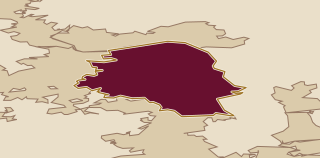
Weinolsheim lies in Rheinhessen, Germany’s largest wine region, and the estate’s holdings include Rheinfront sites. On Gröhl’s Ortswein labels, the locality is part of the wine’s frame rather than decoration: the 2021 Dalheimer Spätburgunder identifies a place of origin alongside the grape, then carries its soil mix and cellar treatment into the glass. The 2023 Blanc de Noir is also an Ortswein, although its fruit came from trusted local growers rather than the estate’s own vineyards.
Rheinhessen is not presented here as a single taste. The two documented wines show why locality and method need to be read together: Spätburgunder from the Dalheimer bottling becomes a ruby-red, wood-aged wine, while immediately pressed Spätburgunder becomes a salmon-coloured white wine with more apparent lift from its 6.2 g/l acidity.
In the cellar
Vineyards and cellar
Organic conversion began in 2022, with cover crops, handwork, reduced yields and late selective harvesting documented in the vineyards. Later harvesting can bring riper fruit into the cellar, while selection avoids asking every bunch to play the same role. The estate also uses sedimentation, spontaneous fermentation, stainless steel, large wooden casks, barriques and extended ageing on fine lees, choosing the vessel and duration according to the wine rather than forcing Riesling and Spätburgunder into one texture.
The 2021 Alte Reben shows the wood-led end of that work: it fermented spontaneously on skins, then spent 24 months in Stückfass and barrique. Skin contact draws colour and tannin from Spätburgunder; the large cask and smaller barrique add texture and light smoke around its dark fruit. The 2023 Blanc de Noir takes the opposite route, with immediate gentle pressing after harvest to avoid pigment extraction, followed by stainless-steel ageing that keeps its colour pale and its berry fruit direct.
Wines to know
The range in view
The documented range includes Riesling and Spätburgunder, with the two Ortsweine offering a useful split in colour, structure and cellar method. The dry 2021 Dalheimer Spätburgunder Alte Reben is a single-variety red at 12.5% alcohol, with no residual sugar, 5.3 g/l acidity and 24 months in wood. Its light ruby colour, tannin and savoury earth place it at the slower, more structured end of the range.
The dry 2023 Blanc de Noir is also entirely Spätburgunder, but it is a pale wine made without skin-colour extraction. At 11.5% alcohol, 6.2 g/l acidity and 4.1 g/l residual sugar, it has less weight than the red and a juicier profile. Stainless steel preserves fresh berry fruit and a lively mineral edge, while the absence of oak leaves the wine’s light salmon colour and brisk texture in view.
A useful way in
A bottle to begin with
Choose the 2021 Dalheimer Spätburgunder Alte Reben trocken. It is a dry, single-variety Spätburgunder Ortswein from Muschelkalk, clay-marl and loess, fermented spontaneously on skins and matured for 24 months in Stückfass and barrique. Dark berries, cherry, dried herbs, earth and light smoke sit over a dry palate with tannin, moderate body and a long savoury finish. This bottle brings vineyard ground, spontaneous fermentation and long wood ageing into one clearly documented red-wine style.