
Why it matters
The producer
Weingut Eymann is a family estate founded in 1961 in Gönnheim, near the Haardt edge and the German Wine Route. Its history records an early move into organic growing in the 1980s; the vineyards are now farmed biodynamically. That long farming commitment sits behind a range built around origin-designated Riesling and Spätburgunder, where grape and site are named together rather than treated as separate ideas.
Vincent Eymann has led the winery since 2015. His direction has concentrated the work on those two grapes while retaining traditional bottle-fermented sparkling wine. The result is a Pfalz range that moves from old-vine Riesling to red wines from calcareous-loess ground, with site names such as Fuchsmantel and Schlossberg carrying real vineyard information onto the label.
Place and vineyards
Where the wines begin
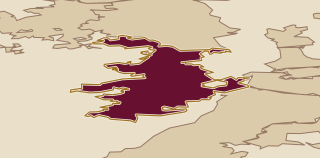
The estate farms just under 18 hectares across Gönnheim, Bad Dürkheim and Wachenheim. Gönnheim is its base, but the spread matters in the bottle: a Riesling labelled Fuchsmantel comes from a Dürkheim parcel, while Schlossberg brings Wachenheim into the estate’s Riesling holdings. The range therefore follows vineyard addresses as well as grape varieties.
Pfalz warmth helps Riesling reach ripe fruit while retaining useful acidity, and it gives Spätburgunder the conditions to build body without leaving its fruit behind. Eymann’s labels narrow that broad regional picture through old vines and named sites, so the wines can be approached as distinct expressions rather than as generic white or red Pfalz wine.
In the cellar
Vineyards and cellar
Biodynamic farming is the estate-wide vineyard framework, but the wines show it through specific material: old own-rooted Riesling, partly ungrafted vines in Fuchsmantel, and soil chosen for Spätburgunder. Old vines do not guarantee one flavour, but they make vine age a meaningful part of these labels and direct attention toward fruit grown from established root systems rather than a young-vine blend.
In the cellar, Fuchsmantel 2020 spent a full year on gross lees. Keeping Riesling on its spent yeast cells can add weight and texture while acidity keeps the palate moving, making this a different proposition from a brisk young varietal wine. For sparkling wine, traditional bottle fermentation creates mousse in the bottle itself, extending the estate’s work beyond still Riesling and Pinot.
Wines to know
The range in view
Riesling provides the white-wine spine. Riesling Alte Reben draws from old own-rooted parcels, including 1930 and 1969 plantings, while Fuchsmantel takes the site-specific route: old, partly ungrafted vines and a year on gross lees produce a wine with more mid-palate weight and lees-derived texture. Schlossberg adds another named Wachenheim address to the Riesling side of the cellar.
Spätburgunder is the red counterpart, with Sonnenberg and Mandelgarten supplying the heavy calcareous loess regarded as especially suitable for the grape. The dry 2018 Toreye Spätburgunder places Pinot’s red-fruit character, tannin and savoury structure in that soil context. Traditional-method sparkling wines complete the range with citrus, fruit and mousse rather than simply repeating the still-wine offer.
A useful way in
A bottle to begin with
Choose Riesling Alte Reben first. It is an old-vine Riesling made from own-rooted parcels that include vines planted in 1930 and 1969, so one bottle brings together Gönnheim, vineyard age and the estate’s central grape. Expect fruit carried by lively acidity with a textured palate rather than a simple, fleeting white-wine profile. It is a direct way into Eymann’s preference for Riesling with a vineyard story attached.