
Why it matters
The producer
Franz and Andrea Proidl run the estate with their son Patrick, the winemaker. Franz and Patrick are the family’s ninth and tenth generations, and the family places its winegrowing at the present Senftenberg address from 1738. That long continuity is expressed through named Kremstal sites rather than a single generic bottling: Ehrenfels, Hochäcker, Pellingen, Pfenningberg and Rameln appear in the estate’s vineyard vocabulary.
The Proidl family traces its arrival from near Bremen to 1650, then dates vine-growing and winemaking at its present Senftenberg site from 1738. Today, Patrick works as winemaker alongside Franz and Andrea, linking the tenth generation to vineyards whose names are carried onto the labels. The result is a family estate whose range follows the distinction between grape and site: Grüner Veltliner is the main planting, while Riesling is reserved for the harsher, drier slopes.
Place and vineyards
Where the wines begin
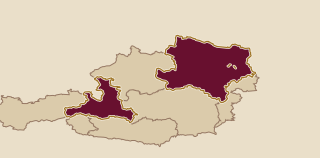
Senftenberg sits at the gateway to Kremstal, where the Wachau meets the forest-and-rock river valleys associated with the Waldviertel. Cool air from the Bohemian Massif meets milder temperatures from the Danube, so grapes ripen in a setting shaped by both freshness and warmth. Grüner Veltliner can retain its herbal, peppery character here, while Riesling is planted where the slopes are driest and steepest.
The local soils are weathered from gneiss, and the vineyards rise sharply above Senftenberg. On south-facing terraces, evaporation can be intense enough for the family to lay straw across the ground. That cover protects the surface from drying so quickly, while the steep ground and rock-based soils remain a physical part of the conditions behind the estate’s single-site wines.
In the cellar
Vineyards and cellar
Each vineyard receives its own management plan, with compost and horse manure applied annually and straw used where terrace conditions demand it. In the cellar, Proidl works with spontaneous fermentation, selective lees stirring, extended ageing on the lees, stainless steel, large-format wood and gravity movement. For wines such as the 2023 Ried Pellingen Grüner Veltliner, this approach includes slow fermentation and time on lees, which supports a juicy middle palate without losing the wine’s firm acidity.
Wines to know
The range in view
The range is organised by grape and individual site. Grüner Veltliner provides the broadest frame, while Riesling occupies the driest, steepest parcels; Ehrenfels, Hochäcker, Pellingen, Pfenningberg and Rameln supply the site names. The most fully documented bottle is the 2023 Ried Pellingen Grüner Veltliner Reserve 1 ÖTW, a 100% Grüner Veltliner from Kremstal. It combines varietal fruit with peppery spice, a robust body and the herbal, apple-and-citrus character recorded for that vintage.
The 2023 Pellingen opens with fresh herbs, yellow apple, lime zest and mineral notes, followed by peach and a delicate fruit sweetness. Its palate is juicy rather than heavy, with acidity running through the fruit and carrying the wine into a long finish. The peppery Grüner Veltliner character, brief 10–12 hour skin contact for part of the fruit, slow native-yeast fermentation and lees ageing help explain why the wine has both flavour density and a clean, persistent line.
A useful way in
A bottle to begin with
Start with Proidl Ried Pellingen Grüner Veltliner Reserve 1 ÖTW 2023. It is a single-site, single-variety Kremstal Grüner Veltliner, listed by Systembolaget, and it gathers the estate’s central details into one bottle: a steep Senftenberg site, part of the fruit macerated on skins, native-yeast fermentation in large wood and stainless steel, then lees ageing until late-August bottling. Expect yellow apple, lime zest, herbs, peach, peppery spice and mineral notes over a juicy texture, firm acidity and a long dry finish.